BTS is thriving. So why are K-pop stocks crashing?
Record earnings and the megastars' comeback failed to stop a broader K-pop stock slump as investors worry about margins, valuations and capital flowing elsewhere.
SHIN HA-NEESHINHA-NEELIFESTYLE & ENTERTAINMENT REPORTER
Published
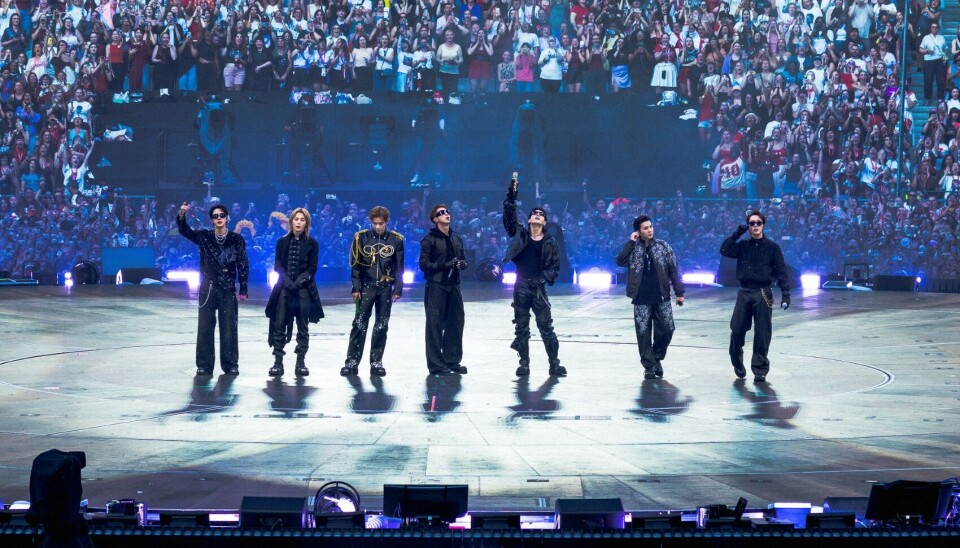
BTS performs during the Busan leg of its “Arirang” world tour at Busan Asiad Main Stadium. The group held two concerts in the city on June 12 and 13, with the second show coinciding with its debut anniversary.BIGHIT MUSIC
“Did BTS enlist again or something?”
That was the half-joking question repeated among analysts after HYBE, the K-pop megastars' agency, reported record quarterly earnings on Tuesday — only to see its shares sink to a fresh 52-week low the following day.
The sell-off was dramatic, but hardly a one-off. HYBE’s share price has more than halved this year, with entertainment stocks tumbling across the board. Not even the return of BTS — the bluest of K-pop’s blue-chip acts — has been enough to reverse the trend.
Analysts argue, however, that concerns might be overblown, pointing to the industry’s longer-term growth prospects.
On Tuesday, HYBE reported an operating profit of 170.9 billion won ($118 million) for the April-to-June period, up 159.3 percent from a year earlier, and 1.45 trillion won in revenue — both quarterly records exceeding market expectations.
Despite the banner performance, however, the label's shares plunged a whopping 16.09 percent that day, an even steeper fall than the benchmark Kospi’s shocking 10.84 percent drop. The price then closed at 170,300 won on Wednesday, down 9.8 percent from the previous session, before falling another 4.76 percent to 162,200 won on Thursday.
An advertisement for boy band BTS's ″Arirang″ comeback performance is played at the Gwanghwamun Square in central Seoul on March 12.NEWS1
By Wednesday’s market close, the stock price had nose-dived 50.8 percent from the first trading day of the year. The benchmark Kospi, meanwhile, was up 31.4 percent over the same period, though the massive volatility also sent the index on a wild ride from its June peak of 9,115.55 to below the 6,000 mark on Wednesday.
“Following the earnings surprise, HYBE is expected to perform strongly through at least the second quarter of next year, supported by BTS’s world tour,” Hana Securities analyst Lee Ki-hoon said in a report published on Wednesday, also citing the expected returns of NewJeans and Seventeen, as well as the rapid growth of Cortis and Katseye.
But Lee believes there is significant undervaluation, as HYBE’s stock price is currently trading at approximately 20 times Hana Securities’ projected earnings for 2027, even below the roughly 22 times during the panic sell-off in 2022, when BTS announced a hiatus from group activities.
One source of concern is profitability.
HYBE headquarters in Yongsan District, central SeoulYONHAP
Although HYBE’s operating profit beat market expectations, its operating margin came to 11.8 percent, below the analyst estimate of 12.7 percent, with one of the factors being the terms of BTS’s renewed contracts that are widely believed to give the members a larger share of the revenue they generate compared to younger, smaller acts.
“Despite the significant growth in both revenue and operating profit, concerns over the expenses from artist revenue-sharing payments weighed on the stock following the earnings announcement,” said Shinyoung Securities analyst Kim Ji-hyun. “BTS’s comeback is translating directly into revenue growth, but the group’s increased revenue-sharing ratio has added to costs, resulting in market concerns over HYBE’s operating profit.”
BTS greets the crowd at "BTS World Tour Arirang in Paris" on July 17 at the Stade de France in Saint-Denis, France.BIGHIT MUSIC
Another problem is that much of the BTS comeback rally had already been priced in. Expectations surrounding the group’s return pushed HYBE stock to its peak for the year in February, leaving it vulnerable once investors began looking beyond the initial surge in album and concert revenue.
At the same time, investor money has been heavily concentrated in large-cap semiconductor stocks, which have driven both the market’s rapid rise and its subsequent plunge this year — leaving sectors such as entertainment relatively starved of capital inflow.
JYP Entertainment, listed on the secondary Kosdaq market, had lost 44.58 percent this year as of Wednesday, while SM Entertainment had fallen 49.62 percent and YG Entertainment 47.37 percent. The Kosdaq declined 29.9 percent over the same period.
The sharp decline, however, has led some analysts to argue that entertainment stocks are now trading below levels justified by their earnings prospects.
“Once the concentration begins to ease, I expect capital to flow back into the entertainment industry, which remains on a structural growth trajectory rather than following a market cycle,” Shin said. “HYBE’s valuation should also begin to normalize by then.”
Korea Investment & Securities chief analyst Jung Ho-yoon also noted, “As Korea’s entertainment industry is still building recognition in the vast Western market, investors should consider looking for buying opportunities from a longer-term perspective.”
Boy band Cortis poses for photos during a press showcase for its second EP, ″GreenGreen,″ held at Yes24 Live Hall in eastern Seoul on April 20.DANIELA GONZALEZ PEREZ