Trump says Korea could pay 'double' if it doesn't sign on to $50B Alaska LNG deal
U.S. President Donald Trump said that he would "double it up" if Korea doesn't participate in the Alaska liquefied natural gas (LNG) project. It is unclear what he intends to double, though foreign media reports have focused on tariffs.
Korean President Lee Jae Myung, right, meets with U.S. President Donald Trump on the sidelines of the Asia-Pacific Economic Cooperation leaders' summit in Gyeongju, North Gyeongsang, on Oct. 29, 2025.REUTERS/YONHAP
WASHINGTON — U.S. President Donald Trump again appeared to use tariffs as leverage over Korea when he warned that he would “double” the burden unless Seoul soon signs on to the Alaska liquefied natural gas (LNG) project.
Washington announced on Wednesday that Seoul had committed to invest more than $50 billion in a LNG project in Alaska — a claim that Korea later said was untrue, as no final decision had been made. Trump’s push for Korea to agree to the project could reopen a trade fight that had begun to recede after Seoul started selecting projects for its $350 billion U.S. investment package.
“I didn’t jump the gun,” Trump said on Friday when reporters asked whether his announcement came hastily.
The U.S. president, however, went on to suggest that Korea would bear a high cost if it declines to participate.
“And let’s see if they don’t want to do it. That’s okay with me,” he said. “[But] I’ll just charge them more.”
Trump’s later remarks indicated that he had not yet heard Korea’s position that no agreement had been reached.
“Wait, wait, wait, they said they didn’t sign off?” he asked after reporters told him that Korea was “still studying” the project.
“Tell them if they don’t sign shortly, I’m going to double it up,” he said.
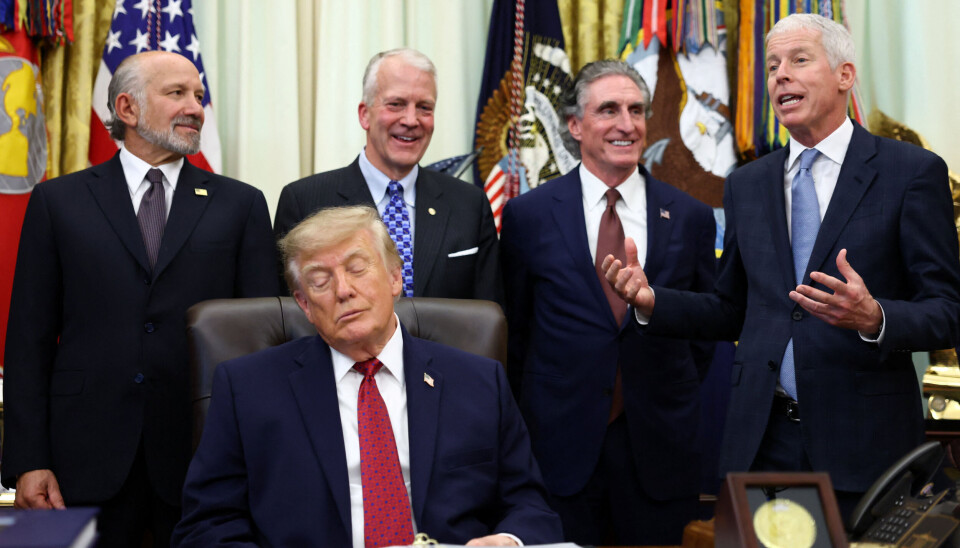
U.S. President Donald Trump, center, at the Oval Office at the White House in Washington on Sept. 30REUTERS/YONHAP
Though Korea and the U.S. Department of Commerce’s own fact sheet left the Alaska project subject to further talks, Trump’s latest comments suggest that those qualifications may not matter to him.
If he treats Korea’s investment in the LNG project as a given, his administration could follow his lead, as few officials seem able to challenge him. This could expose Korea to further investment pressure.
Some in diplomatic circles see Trump’s premature declaration as strategic. They say that he may have cast the Alaska project and the $120 billion project for eight planned nuclear power plants as accomplished facts to put himself in a stronger position for the negotiations still to come.
Earlier on Friday, Trump also announced on Truth Social that Korea would invest $8.4 billion in an oil production project. The project, however, was nowhere in the Korea-U.S. investment agreement.
Regarding his comments about “doubling it up,” it is unclear what exactly Trump intends to double. One possibility is the amount of Korean investment, but foreign media reports have focused instead on tariffs.
“As he apparently threatened to double tariffs on imports from South Korea, Trump repeated his incorrect claim that tariffs on imports are fees paid by the country that exports goods to the United States,” Britain’s The Guardian wrote on Saturday.
U.S. President Donald Trump speaks to reporters before boarding Marine One on the South Lawn of the White House in Washington on Oct. 2.AP/YONHAP
Trump’s reciprocal tariffs on Korea and other trading partners under the International Emergency Economic Powers Act have already been invalidated by the U.S. Supreme Court, which found that the law did not authorize the president to impose them.
But he still has another path to tariffs: Section 301 of the Trade Act.
In March, the Office of the U.S. Trade Representative (USTR) opened an investigation into whether 60 economies — including Korea — were adequately blocking imports made with forced labor. Washington then decided to impose tariffs in July as a result of the probe. For Korean products subject to the measure, the combined tariff rate, including the existing most favored nation duty, was capped at 12.5 percent.
Korean President Lee Jae Myung, right, stands next to U.S. President Donald Trump at the White House in Washington on Aug. 25, 2025.AP/YONHAP
The USTR has also opened an investigation into overproduction across 16 economies, including Korea, China, the European Union and Japan. That probe could provide yet another route to tariffs.
Last year’s deal agreed between the Korean and U.S. leaders centered on a trade-off: Seoul would invest $350 billion in Washington, while Washington would cut its reciprocal and auto tariffs on Korean goods to 15 percent.
The bigger risk for Seoul is that Trump could define the Alaska investment as part of the bargain, regardless of what the agreement actually says. If Korea stays out of the project, he could cast that as a breach of the two countries’ agreement and raise tariffs. Trump already threatened in January to lift tariffs on Korea from 15 percent to 25 percent over investment delays.
Similarly, even other allies have faced harsh measures when tariffs failed to produce the result that Trump wanted. After Canada retaliated against his 50 percent tariffs on $20 billion in Canadian goods, the U.S. president escalated to an embargo on Canadian dairy products, alcohol and motorcycles — a move that demonstrated his willingness to deploy an array of economic tools in pursuit of political goals.
Behind Trump’s aggressive pursuit of U.S.-bound investment lies a worsening midterm picture for Republicans. Alaska has traditionally leaned heavily Republican, but this year’s U.S. Senate contest has developed into a neck-and-neck race.
Korean President Lee Jae Myung, left, shakes hands with U.S. President Donald Trump at the Oval Office at the White House in Washington on Aug. 25, 2025.REUTERS/YONHAP
The electoral pressure is clear in the latest polling. Democrat Mary Peltola stood at 50 percent, and Republican incumbent Sen. Dan Sullivan at 43 percent, according to a survey conducted by The New York Times and Siena University from Sept. 22 through Thursday.
Trump appears to calculate that major investment announcements in Alaska could give voters a tangible economic achievement to associate with his party.
But a late burst of investment announcements may do little to alter the political landscape.
U.S.-based media outlet Politico pointed out that Trump is likely to use the Alaska project, a $15 billion steel plant in Iowa and a $3.2 billion bridge project in Alabama to his advantage.
“[The projects] are earning bipartisan plaudits and could prove an economic boon to the states, should they come to fruition,” Politico reported. It also noted that the earliest any of those projects would be online is 2030.
“Whether it’s a new Alaska pipeline or this steel mill here in Iowa, these are fantastic projects, but politically, there is a tight timeline to leverage them,” Iowa Republican strategist Luke Martz told Politico.
This article was originally written in Korean and translated by a bilingual reporter with the help of generative AI tools. It was then edited by a native English-speaking editor. All AI-assisted translations are reviewed and refined by our newsroom.