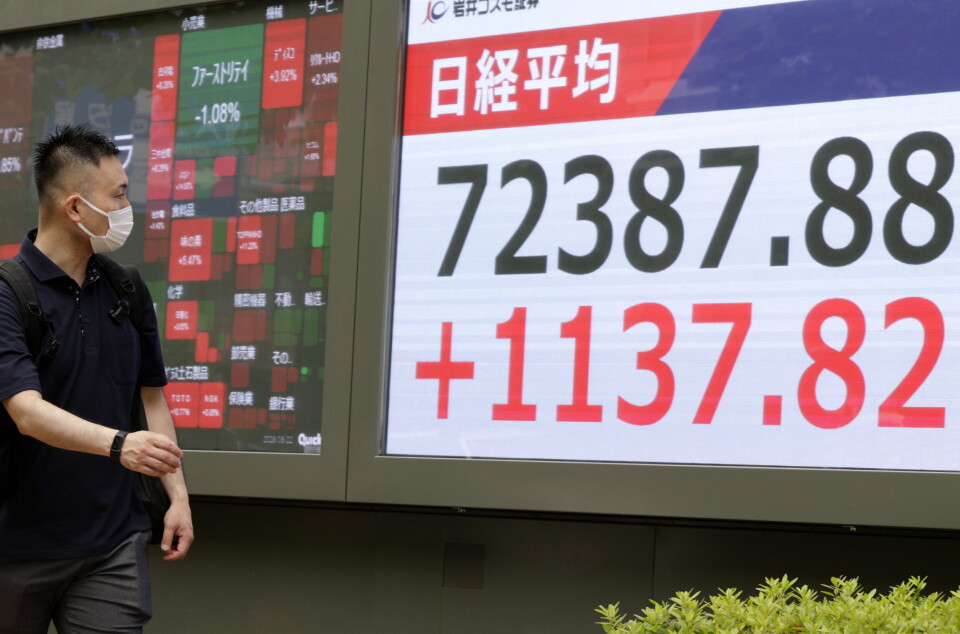
A passerby walks past a stock market indicator screen in Tokyo, Japan, on June 22.EPA/YONHAP
Foreign investors are pulling record amounts of money out of the Korean stock market at a record pace and funneling it into Japan, a market that many see as still having room for further gains.
Foreign investors sold a net 149.05 trillion won ($97.4 billion) worth of Kospi shares during the first half of the year, according to the Korea Exchange on Friday. It marked the largest first-half net outflow on record.
Most of the selling was concentrated in Korea's two major chipmakers, Samsung Electronics and SK hynix.
During the January-June period, foreign investors sold 72.57 trillion won worth of Samsung Electronics shares and 57.13 trillion won worth of SK hynix shares. Together, the two companies accounted for 129.69 trillion won in net selling, or 87 percent of all foreign net sales on the Kospi.
Foreign investors are also pulling back from Taiwan, switching from buyers to sellers last month, according to Reuters.
After purchasing $8 billion worth of Taiwanese stocks in May, they sold a net $8 billion in June. Taiwan recorded the second-largest foreign outflow among major Asian markets after Korea, where net monthly foreign selling reached $12.63 billion.
Japan, meanwhile, has become the biggest destination for foreign money.
Overseas investors bought a net 10.94 trillion yen ($67.93 billion) worth of Japanese stocks in the first half of the year, the Tokyo Stock Exchange said. The figure is five times higher than foreign purchases recorded in the first half of last year.
This year's inflow has already eclipsed the previous first-half record of 8.3 trillion yen, a threshold set when late Prime Minister Shinzo Abe's aggressive monetary easing and fiscal stimulus fueled a market rally in 2013.
A passerby walks past a stock market indicator screen in Tokyo on June 23.EPA/YONHAP
Analysts say Japan's market has become more attractive because it offers broader exposure to the semiconductor industry. In addition to memory chipmaker Kioxia Holdings, Japan is home to many companies that produce semiconductor materials, components and manufacturing equipment.
That broader exposure has made Japan a favorite among global investors.
Japan also ranked as the most preferred stock market in Asia, according to a Bank of America survey of asset managers.
"Korea is a memory trade, Taiwan is a foundry trade and Japan is an economic trade where AI is just an added bonus,” Ajay Rajadhyaksha, global chairman of research from Barclays Investment Bank, said in a report. “If the memory cycle turns, that distinction will separate the winners from the losers.”
Some analysts also believe Japan has more room to rise because its stock market has not climbed as sharply as Korea's this year.
The Kospi jumped 101.14 percent in the first half, while Japan's Nikkei 225 gained 39.18 percent.
“Japan is the most investable Asia[n] market after all, as it’s much bigger and broader,” Chauwei Yak, chief executive officer at hedge fund GAO Capital in Singapore, told Bloomberg. “Even though the Korea market has done better, it’s really like two stocks there.”
The two stocks refer to Samsung Electronics and SK hynix.
If foreign investors continue shifting money to Japan, the Korean stock market could remain under pressure, observers say.
Even on Friday, when the Kospi climbed 5.76 percent to close at 8,088.34, foreign investors sold a net 2.21 trillion won worth of shares, which extended their selling streak to 10 consecutive trading sessions since June 18.
This article was originally written in Korean and translated by a bilingual reporter with the help of generative AI tools. It was then edited by a native English-speaking editor. All AI-assisted translations are reviewed and refined by our newsroom.