Tesla Korea seeks exemption to unlock FSD for China-made cars
The Korean subsidiary of Tesla has requested a government exemption to enable Full Self-Driving on China-made Model 3 and Model Y vehicles, raising whether a software update can qualify as a vehicle device.
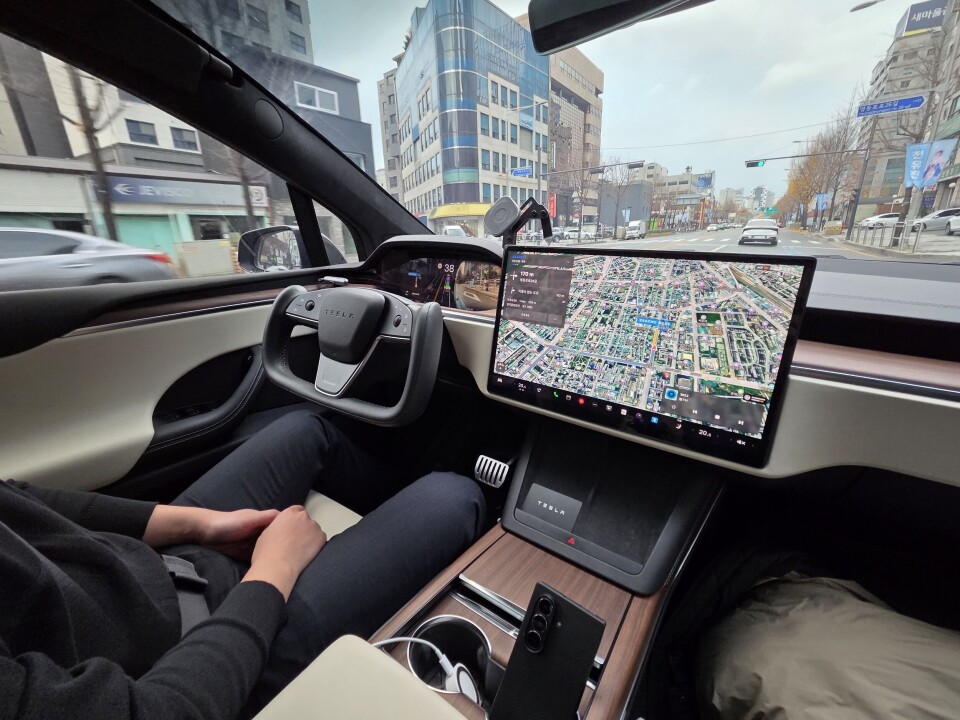
A Model X drives with FSD engaged in central Seoul in November 2025. The feature keeps running without the driver’s hands on the wheel or feet on the pedals as long as the driver watches the road.KIM HYO-SEONG
Tesla Korea has asked the Korean government to let China-made Teslas use its Full Self-Driving (FSD) feature. The request translates to a question regulators have never had to answer: whether a software update counts as a vehicle “device.”
Tesla Korea filed for a special exemption with the Ministry of Land, Infrastructure and Transport on Oct. 22, industry sources said Tuesday. The application cites Article 114-2 of the ministry’s rules on vehicle performance and safety standards, which lets the minister make an exception for a new “device” that is judged to outperform the standards in the rules or to be necessary for safety.
“The request is to allow FSD on China-made Teslas,” a ministry official said, describing the gist of the application.
The sticking point is the meaning of “device.” The provision has so far been applied to physical equipment, such as lighting systems and devices that prevent drivers from pressing the wrong pedal. FSD, by contrast, uses the computer and cameras already built into the car through a software update.
“There has been no case of the exemption being applied to a software update,” the official said. “We need to review the legal issues.”
The provision exists for new technology that the current standards do not mention, but because FSD is software, the ministry first has to decide whether it applies at all.
Safety review is another obstacle. The ministry decides on such requests after a technical review by the Korea Automobile Testing and Research Institute, part of the Korea Transportation Safety Authority. Tesla Korea’s application reportedly did not include the technical data needed for that review. The ministry plans to hold further talks with Tesla on the matter.
The center display of a Tesla Model X shows Full Self-Driving engaged, indicated in the upper left corner, in November 2025.KIM HYO-SEONG
China-made Teslas cannot use FSD because the feature works in a way Korea’s safety standards for steering systems do not allow. The current standards require drivers to keep their hands on the wheel and to operate the turn signal themselves before changing lanes. FSD changes lanes on its own under the driver’s supervision and follows a route through city streets.
Most U.S.-made Teslas, however, can use FSD under a Korea-U.S. FTA provision that recognizes U.S. safety standards.
Of the 238,968 Teslas registered in Korea at the end of September, 183,407 are China-made Model 3 and Model Y cars that cannot use FSD, according to data Tesla Korea submitted to the office of Rep. Chang Jong-tae of the Democratic Party. Some U.S.-made cars with Tesla’s older self-driving computer, HW3, can run FSD, while China-made cars with the newer HW4 computer cannot.
The National Assembly and the government are also working to adopt the international standard for driver control assistance systems (DCAS). These advanced driver assistance features let a car control steering and speed under the driver’s supervision. The United Nations has set a safety standard for the systems, UN Regulation No. 171. A revision to the Motor Vehicle Management Act to adopt it was proposed in July, and the ministry supports it.
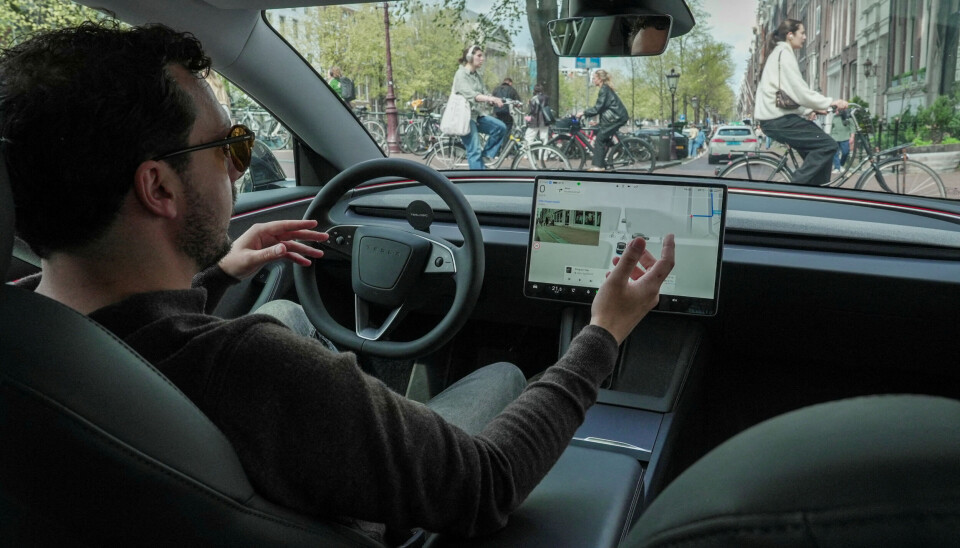
A Tesla driver drives around hands-free with his electric car, several days after Dutch regulators approved the use of Tesla's self-driving software, in Amsterdam on April 17.REUTERS/YONHAP
Even with DCAS, however, drivers could take their hands off the wheel only on expressways and other motorways. That means the U.S. version of FSD, which lets drivers go hands-free on city streets, could not be used as it is.
Europe has been opening the door through exceptions. The Netherlands became the first country to approve FSD in April, under a European Union provision that allows exemptions for new technologies. Belgium, Denmark and others have since accepted the Dutch approval, and about 10 countries now allow it. EU member states are expected to vote as early as December on whether to allow FSD across the bloc.
“It is not directly related, but we need to watch the international discussions,” a ministry official said.
Some in the industry read the ministry’s caution as a hedge against Chinese electric vehicles.
“If China-made Teslas are allowed, the same standard may have to be applied to other Chinese cars, so [the ministry] seems to be taking a conservative approach,” an industry source said. “Tesla’s FSD has been operated and verified around the world. But Chinese companies’ autonomous driving technology has mostly run only inside China, and there is no accurate information on it, so it inevitably needs more verification.”
This article was originally written in Korean and translated by a bilingual reporter with the help of generative AI tools. It was then edited by a native English-speaking editor. All AI-assisted translations are reviewed and refined by our newsroom.