Workers walk by Samsung Electronics' headquarters on Suwon, Gyeonggi, on Oct. 29.YONHAP
Samsung Electronics delivered another record-breaking quarter on Thursday, posting 107.44 trillion won ($80.4 billion) in operating profit. But even that wasn't enough to satisfy investors, whose expectations had climbed with the memory chip boom.
The semiconductor unit accounted for nearly all of the profit at 106.5 trillion won, shy of analyst estimates of more than 107 trillion won.
The slight earnings miss, coupled with a lack of clarity over how Samsung plans to distribute its promised record shareholder returns of up to 110 trillion won this year, weighed on the stock.
Samsung shares fell 4.13 percent from the previous session to close at 232,000 won on Thursday.
The Suwon, Gyeonggi-based tech giant said it would pay a third quarter cash dividend totaling 30 trillion won, or 4,601 won per common and preferred share, on Nov. 27.
However, questions remain over the rest of its shareholder return package. Samsung said an additional 55 trillion won to 75 trillion won would be distributed through share buybacks and cash dividends, without specifying how much would go toward each during Thursday's earnings call.
The uncertainty appeared to overshadow what was otherwise another blockbuster quarter for the world's largest memory chipmaker.
Operating profit surged 783.1 percent from a year earlier, beating a separate market consensus on the company's overall earnings of 106 trillion won compiled by FnGuide. It marked the first time Samsung's quarterly operating profit had crossed the 100 trillion won threshold.
Revenue jumped 126.9 percent on year to 195.25 trillion won, although it missed analysts' forecast of 200.3 trillion won. Net profit rose 514.4 percent to 75.14 trillion won, also falling short of FnGuide's estimate of 87.4 trillion won.
Memory boom vs. overspending concerns
Despite the earnings miss, Samsung painted a confident picture of the memory market, saying strong AI investment and limited chip supply would continue to support demand.
Echoing rival SK hynix's upbeat outlook a day earlier, Samsung said its entire high bandwidth memory (HBM) production capacity for 2027 had already been booked.
The company expects memory supply to remain tight through at least 2028, as demand for increasingly sophisticated HBM chips puts further pressure on production capacity.
"As HBM4E and HBM5 ramp and become more core products, their die sizes will be larger than the previous generations, and there will be a significant increase in metal process layers," said Kim Jae-june, the executive vice president of memory global sales and marketing at Samsung.
Samsung is also seeing more customers seek long-term supply commitments as it has signed long-term agreements with 10 major customers and is negotiating with another 10, some of which are close to finalizing deals.
The interested customers extend beyond major cloud operators to server manufacturers, original equipment manufacturers, system-on-chip developers and companies in the mobile, automotive and networking industries.
"Our target of covering 60 to 70 percent of capacity through 2030 with long-term agreements is looking increasingly achievable," Kim added.
Samsung's HBM4 business is also gaining momentum. Sales of the latest-generation memory chips more than tripled from the previous quarter, accounting for 60 percent of the company's total HBM sales in the third quarter.
The company said samples of its next-generation HBM4E chips had already been distributed to customers and received positive feedback.
Samsung's contract chipmaking business is also benefiting from growing demand for advanced semiconductors.
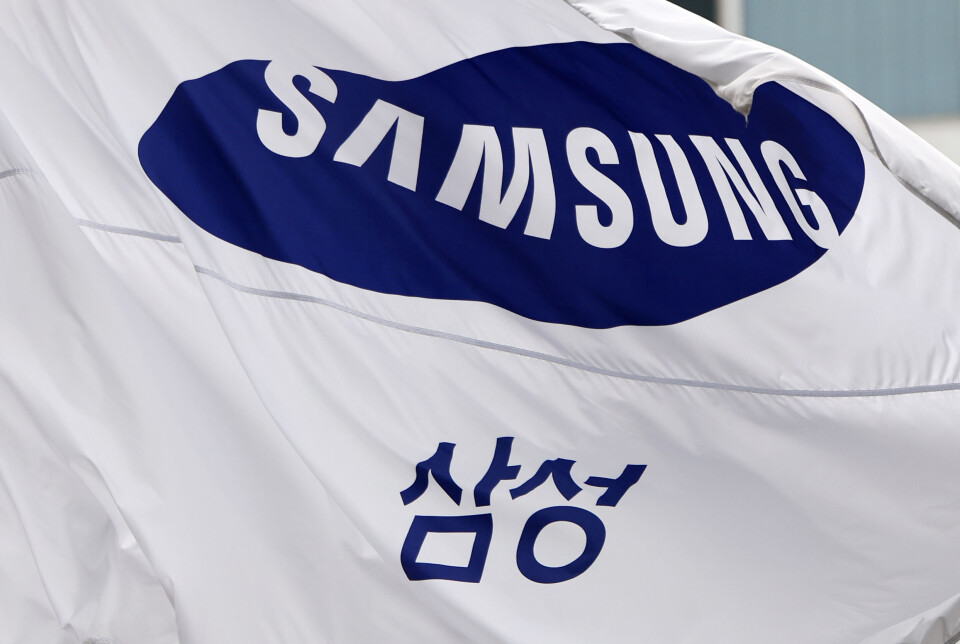
A flag with Samsung Electronics' logo at the company's Seocho office in southern Seoul on Oct. 29.YONHAP
Demand for manufacturing processes below 8 nanometers is exceeding available capacity, while the company secured new 2-nanometer orders from major cloud service providers and AI high-performance computing customers during the quarter.
Samsung expects its 2-nanometer orders this year to more than double from a year earlier.
Progress is also underway at its semiconductor manufacturing complex in Taylor, Texas, where the first factory is expected to begin operations this year. Construction of a second factory is also scheduled to start before year-end.
"For the Taylor site, we have commenced clean room operations at Fab 1 and started equipment installations, while wafer input for line setup is underway, specialists have been sent from the head office and the project is proceeding as planned," said Kang Suk-chae, the executive vice president of Samsung's foundry business.
Analysts divided over pace of AI investments
The record earnings and strong chip demand outlook prompted several brokerages to maintain their bullish views on Samsung, although concerns remain over whether the AI investment boom can sustain its current pace.
Yuanta Securities raised its target price for Samsung to 690,000 won from 630,000 won, while Hanwha Investment & Securities maintained its target at 580,000 won.
BNK Investment & Securities remained considerably more cautious, keeping its target price at 270,000 won.
Korean President Lee Jae Myung, center, Samsung Electronics Chairman Lee Jae-yong, left, and SK Group Chairman Chey Tae-won, right, attend an announcement event on building a new computer chipmaking hub, at the Blue House presidential office in Seoul on June 29.AP/YONHAP
Hanwha Investment & Securities analyst Park Jun-young said financial difficulties facing some smaller AI cloud operators should not be taken as a sign that the broader AI investment cycle is weakening.
"The credit risk of some neocloud companies should not be read as a broader pullback in AI investment," Park said. "Major hyperscalers have room to keep investing, backed by a solid operating cash flow, and the commercialization of AI services and rising inference demand are expected to support memory demand growth."
BNK Investment & Securities analyst Lee Min-hee, however, warned that the pace of AI infrastructure investment may have peaked in the third quarter of this year.
"Big tech companies will keep facing weaker free cash flow and funding pressure," Lee said.
Rising chip costs weigh on other businesses
While Samsung's semiconductor business continued to rake in record profits, soaring chip prices took a toll on its other divisions.
The mobile and network equipment division, which includes Samsung's smartphone business, swung to an operating loss of 600 billion won despite strong sales of flagship smartphones and new foldable devices.
Higher component costs, including more expensive memory chips, weighed on profitability.
The consumer electronics division, which oversees TVs and home appliances, also posted an operating loss of 200 billion won.
TV sales weakened after demand tied to major global sporting events faded, while the home appliance business faced higher raw material and logistics costs despite solid sales.
Samsung Display reported an operating profit of 1.1 trillion won, down 8.33 percent from a year earlier, as weaker sales and higher costs squeezed margins.
Harman, Samsung's automotive electronics subsidiary, was among the few businesses outside semiconductors to report profit growth.
Its operating profit rose 50 percent on year to 600 billion won, supported by seasonal demand and stronger sales of automotive electronics.