Samsung’s cash pile raises stakes for shareholder returns after SK hynix buyback
With 167 trillion won ($119.8 billion) in net cash, Samsung is weighing bigger dividends and buybacks against semiconductor and new-business investment.
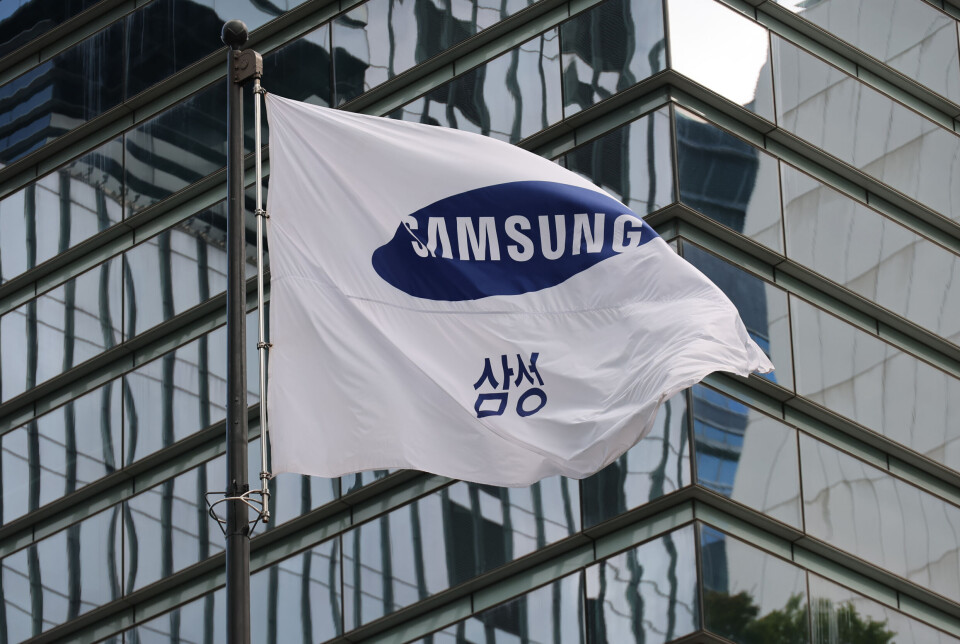
Samsung Electronics' flag in front of the company's Seocho office in southern Seoul on July 30, the day the company released its second quarter earningsYONHAP
SK hynix’s decision to buy back and cancel 40 trillion won ($28.7 billion) worth of its own shares has turned attention to what rival Samsung Electronics will do next for shareholders. The key question is how much of the massive cash pile Samsung has built up during the AI memory chip boom will go back to shareholders, and how much will be reinvested in semiconductors and new businesses.
Samsung Electronics is currently working out how to implement its current shareholder return policy, including a special dividend, as well as a new shareholder return policy that will take effect in 2027, according to industry sources on Thursday.
“We are discussing how to strike the optimal balance between reinvestment for future growth and shareholder returns,” Samsung Electronics Chief Financial Officer Park Soon-cheol said during the company’s recent second quarter earnings call. “We will share the details soon.”
Under its current policy, Samsung returns half of its free cash flow (FCF) — the cash left over after spending on factories, equipment and other investments — generated between 2024 and 2026 to shareholders.
The company pays about 9.8 trillion won in regular dividends annually and provides additional shareholder returns through special dividends, as well as through share buybacks and cancellations when extra funds are available.
Samsung’s net cash stood at about 167 trillion won by the end of the second quarter. With the memory chip boom strengthening its cash-generating power, shareholder returns are expected to increase.
Analysts estimate Samsung could have roughly 120 trillion won to 130 trillion won available for additional shareholder returns once its current three-year policy is settled. Some estimates go as high as 200 trillion won if the next policy further strengthens returns and semiconductor earnings remain strong.
A Samsung Electronics logo appears in this illustration taken Aug. 25, 2025.REUTERS/YONHAP
How Samsung chooses to return that cash will also be closely watched.
SK hynix said Wednesday that it will buy back 24.07 million shares and cancel all of them. The chipmaker also raised its shareholder return target from “within 50 percent” of cumulative FCF generated between 2025 and 2027 to “50 percent or more,” alongside planned cash dividends.
Other global memory chipmakers are also stepping up shareholder returns. U.S.-based Micron Technology and SanDisk have both said they intend to return all excess cash to shareholders once they’ve made the investments needed to sustain their businesses long term. That's fueled expectations that Samsung could raise its own 50 percent payout ratio under its next policy.
Still, many analysts caution that Samsung cannot simply copy its U.S. rival’s playbook. Unlike companies focused primarily on memory, Samsung spans semiconductors, smartphones, home appliances and displays, giving it a much broader set of investment needs.
The company plans to invest more than 110 trillion won this year in research and development and production facilities to strengthen high bandwidth memory (HBM), advanced foundry operations and semiconductor packaging technology. It also needs funds for potential mergers and acquisitions in areas including robotics, medical devices, automotive electronics and heating, ventilation and air conditioning.
From left, the flag of Samsung Electronics at the company office in Seocho District, southern Seoul and the logo of SK hynix is seen outside the company's headquarters in Icheon, Gyeonggi.YONHAP
Samsung has recently drawn on both share buybacks and special dividends to return cash. After unveiling a 10 trillion won share buyback plan in 2024, it canceled about 8.4 trillion won worth of shares acquired to enhance shareholder value. In January, the company also paid a special dividend of 1.3 trillion won on top of its regular payout.
Analysts expect the company could again combine special dividends with share buybacks and cancellations.
“Semiconductor profits fluctuate sharply depending on market conditions, so stronger earnings during an upcycle can be viewed as temporary,” said Shin Joong-ho, head of the research center at LS Securities. “If Samsung Electronics clearly sets standards for regular dividends and share buybacks and cancellations and presents them as a sustainable policy, it would signal the company’s confidence in its future cash-generating capacity.”
This article was originally written in Korean and translated by a bilingual reporter with the help of generative AI tools. It was then edited by a native English-speaking editor. All AI-assisted translations are reviewed and refined by our newsroom.