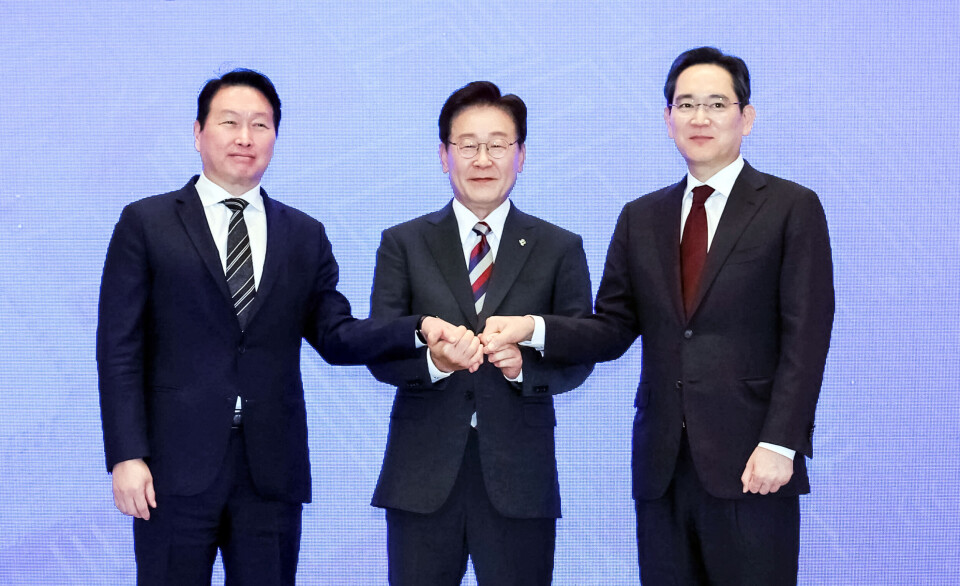
From left, SK Group Chairman Chey Tae-won, President Lee Jae Myung, and Samsung Electronics Executive Chairman Lee Jae-yong join hands after $520 billion investments for four new chip plants at the Blue House in Jongno District, central Seoul, on June 29.JOINT PRESS CORPS
Samsung Electronics and SK hynix announced plans to invest a record 800 trillion won ($520 billion) to build four new chip facilities in the country's southwest region, with critical details such as site locations and timelines unclear.
Combined with the two chipmakers’ ongoing investments in southern Gyeonggi, their total planned spending on chip facilities is set to exceed 4.7 quadrillion won over the coming decades.
Samsung's 400 trillion won outlay will establish two new factories in Gwangju, although details on production capacity and construction timelines have yet to be disclosed.
The chipmaker also plans to build two new high bandwidth memory (HBM) facilities in Onyang and Cheonan, both in South Chungcheong.
SK hynix will also invest 400 trillion won to build two new chip plants in the southwest region, though the specific location was not mentioned.
An additional 100 trillion won will be allocated to build a new NAND facility in Cheongju, North Chungcheong, the company’s existing production hub, while further strengthening its advanced packaging capabilities for back-end semiconductor processing.
The investment package comes as Korea seeks to align its semiconductor ambitions with President Lee Jae Myung’s pledge to revitalize regional economies. The plans were unveiled at an event hosted by Lee at the Blue House on Monday, where the president outlined the three "megaprojects" — semiconductors, physical AI and AI data centers — with Samsung Electronics Executive Chairman Lee Jae-yong and SK Group Chairman Chey Tae-won in attendance.
President Lee Jae Myung, center, and Samsung Electronics Executive Chairman Lee Jae-yong bow to each other after the company's massive investment in the southwest region at the Blue House in Jongno District, central Seoul, on June 29.JOINT PRESS CORPS
President Lee Jae Myung, center, and SK Group Chairman Chey Tae-won bow to each other after the company's massive investment in the southwest region at the Blue House in Jongno District, central Seoul, on June 29.NEWS1
"The global AI race has become both an all-out war and a highly localized battle for strategic advantage,” President Lee said during the event. “The southwestern coast is rich in water resources and, in particular, renewable energy. We must develop regions with abundant power, water supplies and stable access to affordable land into new strategic sites.”
“We will establish a dedicated task force within the Blue House to take full responsibility for these projects and ensure they are carried through to completion.”
SK Telecom, GS and Naver, meanwhile, will invest a combined 550 trillion won to build AI data centers with a total capacity of 8.4 gigawatts — 5 gigawatts for SK, 2.4 gigawatts for GS and 1 gigawatt for Naver.
SK's data center capacity will be expanded to 15 gigawatts by 2035, which will lift the country's total capacity to 18.4 gigawatts.
"The latest project will serve as a foundation to shift Korea from a country that consumes AI to a country that exports AI," SK Chairman Chey said at the event.
Korea also unveiled its road map for physical AI, with plans to deploy more than 1,000 AI-powered robots annually across the manufacturing sector. The government will accelerate humanoid robot mass production to keep pace with China’s rapid advances in robotics.
Samsung said it will establish a dedicated production line in Gumi, North Gyeongsang, for the mass production of physical AI systems and humanoid robots.
Hyundai Motor has already pledged 9 trillion won to build the country's first dedicated robot manufacturing complex in Saemangeum, North Jeolla.
Beyond these flagship projects, additional investments were unveiled across regional hubs, including Samsung's new heat pump and air-conditioning equipment production facilities in Gwangju to support future AI data center infrastructure, although details on timelines remained scarce.
Samsung C&T said it will invest in renewable energy projects in the Honam region — encompassing Gwangju, North Jeolla and South Jeolla — including solar power generation facilities, nuclear-powered hydrogen production infrastructure and a demonstration complex for green hydrogen research and development.
Regarding questions over unclear timelines, presidential chief of staff Kang Hoon-sik said in a press briefing after the event that the government aims to complete the new facilities "within the current administration."
View of massive chip cluster under construction in Yongin, Gyeonggi, on June 29.YONHAP
The government also pushed back against concerns over potential water shortages with multiple semiconductor fabs in the southwest region.
“There is currently a capacity of 240,000 tons of available water from existing dams, including 110,000 tons from Jangheung, South Jeolla, and 50,000 tons from the Seomjin River,” Kang said. “There are also 190,000 tons of unused water capacity from over-allocated resources, while an additional 300,000 tons can be secured through wastewater recycling.”
Samsung Electronics and SK hynix are also moving up the completion of the Yongin chip complex by 12 years to double memory production capacity within five years.
Triggered by the AI boom, the global chip market is expected to reach $1.51 trillion this year, up 90 percent from last year, according to the World Semiconductor Trade Statistics.
Around 90 percent of the global DRAM market is dominated by three companies — Samsung, SK and U.S.-based Micron — with Samsung standing as No. 1 with a 38 percent share, followed by SK hynix at 29 percent. In the HBM segment, SK hynix ranked first with a 58 percent market share.
Samsung reported an operating profit of 57.23 trillion won in the first quarter of the year, over seven times higher than a year earlier, surpassing its entire annual operating profit from last year in just three months. SK hynix posted an operating profit of 37.61 trillion won during the same period, up 405.5 percent from a year earlier.
Samsung shares closed at 323,000 won on Monday, down 4.86 percent compared to the previous trading session, while SK hynix fell 1.68 percent to just under 2.63 million won.