
Record profits fail to shield Samsung, SK hynix stocks as AI spending fears rattle markets
Shares of Google and Intel nose-dived on U.S. markets, highlighting investor concerns that Big Tech’s AI spending spree may not deliver sufficient returns.

Published
Modified

Even record-breaking earnings were not enough to keep stock prices afloat for Big Tech — and subsequently, Korea's champion chipmakers Samsung Electronics and SK hynix.
As the market cap of Google's parent company Alphabet plunged by $500 billion overnight and Intel's market cap nose-dived $140 billion, Samsung Electronics and SK hynix also stumbled despite posting record earnings in the latest quarter, raising fears that major tech stocks may fall even further when the market's opening bell rings on Monday.
Analysts attribute investors' shift in focus from how quickly Big Tech companies are growing to whether their massive investments in AI are generating sufficient returns.
Rolling in the deep despite record profit
Samsung Electronics shares closed at 225,000 won ($168.50) on Friday, down 3.02 percent from the previous session, while SK hynix plunged 7.08 percent to 1,418,000 won. As the country's leading semiconductor stocks faltered, the Kospi also fell 3.48 percent to close at 5,730.74.
The declines make little sense when just looking at earnings. Samsung Electronics and SK hynix generated a combined operating profit of approximately 190 trillion won in the third quarter from their semiconductor businesses alone: Samsung Electronics' Device Solutions (DS) division recorded 106.5 trillion won, while SK hynix posted 83.33 trillion won.
Orders are also piling up for the two giants. Samsung Electronics has signed long-term agreements (LTA) with 10 major customers and has already sold out its entire high bandwidth memory (HBM) production capacity for next year. SK hynix has signed LTAs with 14 customers and said its DRAM and HBM production capacity is effectively sold out through 2029 when demand still under negotiation is included.

The AI boom has also spread to components and equipment manufacturers. Samsung Electro-Mechanics posted a record operating profit of 691 billion won in the third quarter, a 165 percent surge from a year earlier. LG Electronics also said its orders for cooling equipment used to manage heat at AI data centers exceeded 3 trillion won this year.
“As production capacity for components and equipment is increasingly being directed toward AI data centers, supply shortages are spreading across all product categories,” said Park Jun-seo, an analyst at Mirae Asset Securities.
Big checks and big falls
The sell-off began with concerns over AI investment that swept through U.S. technology stocks.
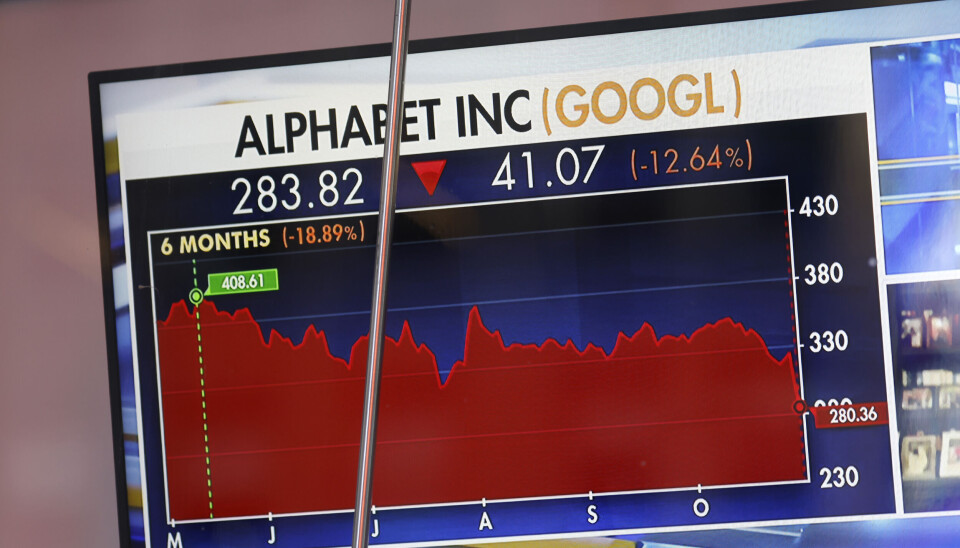
Alphabet shares plunged 12.6 percent to close at $283.82 on the Nasdaq on Thursday, and continued its losing streak Friday when it closed at $278.22. The decline wiped approximately $500 billion off its market capitalization in a single day, marking the second-largest one-day loss in market value in Wall Street history.
Profitability weighed down on Alphabet. Although its third quarter cloud revenue surged 103 percent, capital expenditures more than doubled from a year earlier to $51.4 billion. As a result, free cash flow fell to negative $9.1 billion and remained in the red for a second consecutive quarter.
“Until Google shows it can charge for AI the way it once charged for search ads, every capital spending forecast it issues is going to read less like ambition and more like a bill,” said Thomas Monteiro, a senior analyst at Investing.com.
Other Big Tech companies face similar challenges.
Intel's stock closed at $65.76, down 28.6 percent from a day earlier — the biggest fall for the company since 1974. Meta recorded negative free cash flow of $2.12 billion in the third quarter, while Amazon's free cash flow deficit over the past 12 months widened to $42.4 billion, up sharply from $7.6 billion three months earlier.
Companies are increasingly turning to debt to cover funding shortfalls caused by their massive investments in AI infrastructure.
The five major cloud companies — Microsoft, Alphabet, Amazon, Meta and Oracle — issued approximately $230 billion in corporate bonds from January through September this year, more than double the amount issued throughout last year, according to the Bank of Korea.
“Artificial intelligence companies have been borrowing hundreds of billions of dollars, selling fresh stock, and cooking up novel and potentially risky methods of financing.,” The Washington Post reported.
AI bubble turns into AI trouble

The same concerns help explain why Samsung Electronics and SK hynix have struggled despite their record earnings. If Big Tech companies' capacity to invest weakens, the memory chip boom may not be sustainable.
“Growth in Big Tech's AI infrastructure investment is expected to peak in the third quarter of this year,” said Lee Min-hee, an analyst at BNK Securities. “Their deteriorating free cash flow and capital-raising challenges will persist.”
Moody's also forecast that financially vulnerable companies would face tests of their ability to refinance debt as maturities become concentrated between 2027 and 2029.
The key question is ultimately whether these investments can generate profits.
“Until now, investors have focused on upward revisions to capital expenditure forecasts,” said Kang Jin-hyuk, a senior researcher at Shinhan Securities. “But going forward, they will also need to examine whether monetization justifies those expenditures, whether companies have sufficient free cash flow and whether credit spreads — the difference between corporate bond yields and government bond yields — are widening.”
BY KIM SU-MIN, YOON SO-YEON [[email protected]]


