Paju AI data center at heart of LG U+'s $3.3 billion order push
LG U+ says its new Paju data center, already fully contracted for its first building, will anchor a 5 trillion won push into AI infrastructure by 2030.
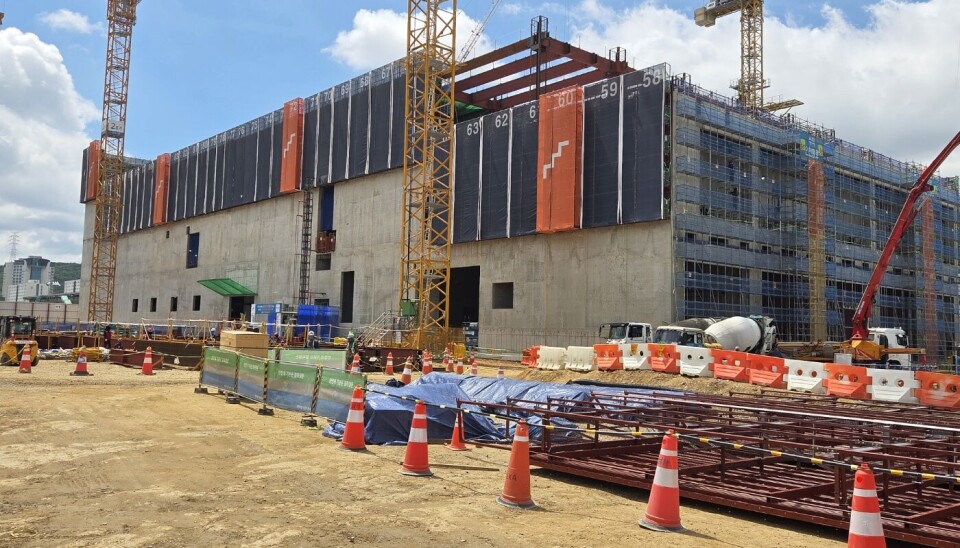
LG U+ data center construction site in Paju, Gyeonggi, on June 5.LG UPLUS
PAJU, Gyeonggi — The heat hit first, then the dust. Cranes swung overhead against a hazy sky as concrete pump trucks idled below, and inside the half-built shell of Building 1, the air was thick with the grit of a site that is only about 20 percent finished.
Workers in hard hats threaded between bare concrete columns that climb five stories, past pipe racks already roughly 70 percent installed, while reporters in borrowed safety vests picked their way along a marked corridor. This raw, unfinished floor, a first-floor machine room still open to the elements, is where LG U+, the country's telco provider, on Friday chose to make its pitch.
The Paju AI Data Center, rising upon a 22,000-pyeong (72,727 square-meters) lot in Wollong-myeon, Gyeonggi, is the centerpiece of a strategy the carrier unveiled on-site to win 5 trillion won ($3.3 billion) in cumulative AI data center orders by 2030 and remake itself into what it calls an "AI Factory Operator."
With a confirmed 200-megawatt power supply, it will be the only hyperscale-class facility of its size in the greater Seoul area, capable of powering the entire capital region's generative AI services at once.
The clearest sign of demand was delivered even before the cement had dried. Building 1, due for completion next June, is already sold out. The 50-megawatt structure, carrying about 30 megawatts of actual IT load, has been fully contracted to what the company would only describe as a large customer.
LG U+ expects more than 1 trillion won in annual orders through 2030 and projects average annual revenue growth of 15 to 20 percent for the business.
LG U+ data center construction site in Paju, Gyeonggi, on June 5.LG UPLUS
Standing on the concrete floor of the unfinished building, executives sketched out a site that will eventually hold five buildings across roughly 152,000 square meters (1.64 million square feet), more than 20 football pitches of floor space.
"The competitiveness of an AI data center now depends not on the scale of the facility but on how stably you can operate the entire infrastructure," said Ahn Hyurng-gyoon, vice president of LG U+'s Enterprise AI Business Group, his keynote address competing with the ambient clatter of the site.
Ahn pointed to a surge in demand as the industry shifts from training AI models to running them, noting that monthly token-processing volumes have climbed roughly 67-fold over the past year.
Ahn organized the company's case around power, cooling, construction speed and operational stability. The power comes from a 345-kilovolt substation across the road, visible past the rebar and scaffolding, with a 154-kilovolt line as backup.
Both run underground at a depth of about nine meters, which the company said eliminates the electromagnetic field concerns that often draw complaints near data centers. Officials said the supply was locked in after a formal power-impact assessment last August, and that opposition has been muted because the site sits inside a former LG Display industrial complex.
LG U+ data center construction site in Paju, Gyeonggi, on June 5.LG UPLUS
Cooling is where the building's bones have been shaped most deliberately. Paju is being built as Korea's first hyperscale center to run both air and liquid cooling in a hybrid structure, with floor loads, waterproofing and piping engineered for liquid from the design stage. Pointing to the columns flanking the machine room, field-team official Kim Jong-jin explained that every pipe is laid so a tenant can switch to liquid the moment its servers demand it.
The primary method, direct-to-chip cooling developed with LG Electronics, attaches a cold plate to the chip and circulates coolant to pull heat away at the source, improving energy efficiency by about 24 percent over air cooling in the company's tests. All three computing floors of Building 1, floors three through five, are designed for it.
The company has spent the past year validating liquid cooling in a proof-of-concept room at its Pyeongchon center, including both direct-to-chip and immersion methods, and will conduct full commercial verification in a live server room later this year, ahead of Paju's 2027 opening. Immersion cooling, even more efficient, awaits further certification before adoption.
Operational stability, the company said, rests on a 27-year record as the only Korean operator to maintain 99.999 percent uptime, a bar it says grows harder to meet at the 200-megawatt scale. Robots will patrol the finished halls around the clock to track temperature, humidity, leaks and dust across grounds spanning some nine football pitches. LG U+, which opened Korea's first internet data center in 1999 and now runs 16 nationwide data centers, is betting that Paju will become the template for the rest.
"AI infrastructure is becoming a core foundation that determines national competitiveness," Ahn said. "As the first IDC operator in Korea, we will expand the foundation of the country's AI industry on the capabilities we have built."




![북한, 잠수함발사 전략순항미사일 시험발사 (평양 조선중앙통신=연합뉴스) 북한 미사일총국이 지난 14일 김정식 당 중앙위원회 제1부부장, 장창하 미사일총국장 등이 참관한 가운데 조선 동해에서 2종의 잠수함발사 전략순항미사일을 시험발사했다고 조선중앙통신이 15일 보도했다. 2026.10.15 [국내에서만 사용가능. 재배포 금지. For Use Only in the Republic of Korea. No Redistribution] nkphoto@yna.co.kr/2026-10-15 08:57:38/](https://image.koreajoongangdaily.com/12922786.jpg?imageId=12922786&panox=0.00&panoy=0.00&panow=100.00&panoh=100.00&heightx=47.66&heighty=0.00&heightw=40.48&heighth=100.00&width=960&height=720&format=webp&format=jpg)


