Nearly $1 trillion in deals: Big Tech, Korean chipmakers align to steer future of AI
Samsung and SK are pursuing long-term AI chip and infrastructure deals valued at $950 billion with major U.S. tech companies amid a deepening semiconductor shortage.
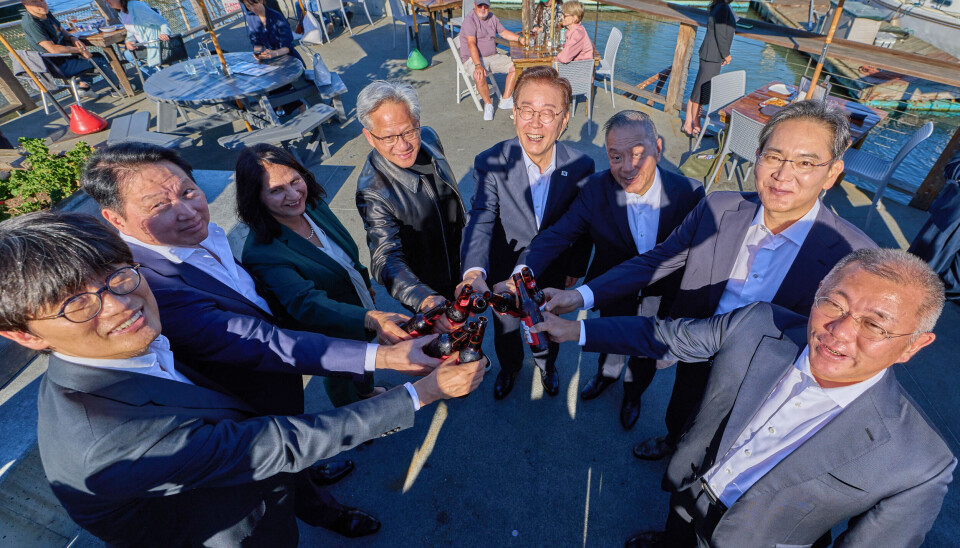
From left: Naver Chairman Lee Hae-jin, SK Group Chairman Chey Tae-won, Microsoft’s Azure Hardware Systems and Infrastructure President Rani Borkar, Nvidia CEO Jensen Huang, Korean President Lee Jae Myung, Broadcom CEO Hock Tan, Samsung Electronics Executive Chairman Lee Jae-yong and Hyundai Motor Group Executive Chair Euisun Chung pose for a photograph during a gathering held in San Francisco on July 24.JOINT PRESS CORPS
Big Tech leading the global AI industry is entering into massive long-term partnerships with Korean semiconductor companies to secure chip supplies amid a deepening shortage stemming from the fierce AI race.
Industry insiders say the agreements signal the emergence of an AI ecosystem alliance in which companies are seeking to secure the entire AI supply chain — from AI memory and advanced foundry manufacturing to chip packaging and data center construction.
Samsung Electronics and Broadcom have agreed to collaborate in memory chips and foundry manufacturing under a five-year partnership worth $200 billion, according to industry sources on Sunday.
At the same time, SK Group is pursuing memory supply agreements worth a combined $750 billion with Nvidia, Microsoft and Anthropic.
Together, the planned partnerships by Samsung Electronics and SK — the two leaders in Korea's market and economy at large — are collectively valued at $950 billion.
Industry observers say Korean chipmakers are moving beyond their traditional role as contract suppliers to become strategic partners helping shape the AI road maps of global technology companies.
Samsung Electronics is expected to supply Broadcom — which designs custom AI application-specific integrated circuits (ASIC) for Google — with next-generation high bandwidth memory (HBM) products, including sixth-generation HBM4 and seventh-generation HBM4E.
The company also plans to offer a turnkey solution integrating its 2-nanometer foundry process with advanced chip packaging.
“As AI infrastructure continues to scale, close collaboration across the semiconductor ecosystem becomes increasingly important,” Charlie Kawwas, president of the Semiconductor Solutions Group at Broadcom, said.
Samsung Electronics Executive Chairman Lee Jae-yong, left, speaks alongside Nvidia CEO Jensen Huang, center, and Korean President Lee Jae Myung during the San Francisco AI Summit held in the United States on July 24.NEWS1
SK Group has signed a comprehensive letter of intent with Nvidia covering cooperation worth more than $500 billion.
Under the agreement, SK Telecom will receive large-scale supplies of Nvidia GPUs to build an AI factory with up to two gigawatts of computing capacity in Korea. It also plans to deploy Nvidia's next-generation Vera Rubin AI systems equipped with SK hynix's HBM4 memory.
SK hynix and Nvidia will jointly develop and optimize next-generation AI memory, including HBM4 for Vera Rubin systems, from the earliest stages of product development.
Behind the massive commitments by U.S. technology companies lies a worsening shortage of memory semiconductors. As the AI industry expands rapidly, demand for advanced memory has surged, making timely access to chips critical to maintaining competitiveness.
At the center of the AI infrastructure race is the HBM market, where Samsung Electronics and SK hynix hold a commanding position.
From left: Samsung Electronics Executive Chairman Lee Jae-yong, SK Group Chairman Chey Tae-won, Hyundai Motor Group Executive Chair Euisun Chung and Nvidia CEO Jensen Huang are seen during the San Francisco AI Summit held in the United States on July 24.NEWS1
The two companies together accounted for 79 percent of global HBM revenue as of the first quarter of 2026, according to technology market research firm Counterpoint Research.
In fact, SK Group Chairman Chey Tae-won said Friday that Nvidia CEO Jensen Huang asks for "more chips" every time they meet.
Industry sources also expect the partnerships to strengthen the Korea-U.S. semiconductor alliance as Washington and Beijing compete for leadership in AI.
"The United States has secured access to Korea's unmatched manufacturing capabilities while further reinforcing its efforts to contain China," a business source said. "Korea, in turn, has secured an indispensable position in the global AI ecosystem."
This article was originally written in Korean and translated by a bilingual reporter with the help of generative AI tools. It was then edited by a native English-speaking editor. All AI-assisted translations are reviewed and refined by our newsroom.