More than half of unemployed young Koreans report experiencing burnout, survey finds
Among unemployed respondents, 68.4 percent named career anxiety as the main cause of their burnout, 9.9 percent selected disillusionment with work and 7.1 percent listed work-life imbalance.
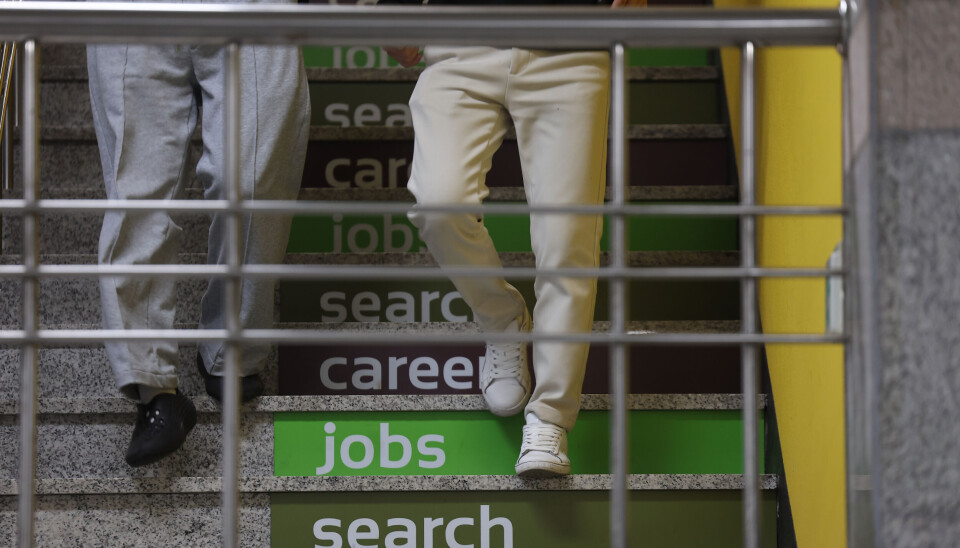
Job seekers look at job listings at an employment and welfare plus center in Mapo District, western Seoul, on Aug. 12.NEWS1
More than half of unemployed young Koreans experienced burnout related to anxiety over their career path or other factors, a survey showed on Monday. Among those who had been job hunting for more than a year, more than six in 10 reported feeling emotionally exhausted.
The Federation of Korean Industries (FKI) said that its analysis of microdata from the Office for Government Policy Coordination’s “2024 Survey on the Lives of Young People” (translated) — defined by the government as those between the ages of 19 and 34 — found that 52.7 percent of unemployed participants reported experiencing burnout, about 1.6 times higher than the 32.4 percent burnout rate among their employed counterparts.
The risk of burnout rose in tandem with the job hunt’s duration. Among unemployed young people who had been searching for work for a year or longer, 61.8 percent reported experiencing burnout.
Burnout rates also varied sharply by employment type.
Temporary and daily workers, whose employment is less stable, reported a burnout rate of 41.1 percent, about 1.4 times higher than the 29.6 percent rate among employees in regular, permanent positions.
The analysis noted that as the average time for a young person to land their first paid job has lengthened over the past five years, their emotional exhaustion appears to be exacerbated by a difficult job market and unstable employment.
Both unemployed young people and young temporary and daily workers most often cited career anxiety as the leading cause of their burnout.
An employment support center at a university in Seoul on April 20YONHAP
Among unemployed young people, 68.4 percent named career anxiety as the main cause, 9.9 percent selected disillusionment with work and 7.1 percent listed work-life imbalance.
Among young temporary and daily workers, 57 percent also listed career anxiety as their No. 1 reason. No. 2 was excessive workload at 13.6 percent, followed by disillusionment with work at 12.1 percent.
By contrast, the leading causes of burnout were more evenly distributed among young workers in regular positions, with 23.2 percent citing excessive workload, 20.5 percent citing career anxiety and 19.9 percent citing disillusionment with work.
The FKI recommended strengthening active labor market policies, including vocational training and employment services, to ease youth burnout.
After analyzing what kinds of support young people who experienced burnout due to career anxiety said that they needed to prepare for employment, change jobs and improve their work-related skills, the FKI found both unemployed young people and young temporary and daily workers voiced a strong need for financial support for job-seeking costs, vocational training and employment counseling services.
The analysis also pointed to shortcomings in how well Korea’s vocational training system is linked to the actual workplace.
According to the Organisation for Economic Cooperation and Development (OECD), institution-based vocational training accounted for 82.1 percent of Korea’s total vocational training spending in 2024, well above the 67.4 percent average across the OECD’s 31 member states.
Workplace-based vocational training, by contrast, accounted for just 1.5 percent of spending, far below the OECD average of 11.7 percent.
“Given the high level of demand from young people for policy support, we need to improve the accessibility and effectiveness of employment services, such as by providing financial support for job-seeking costs and employment counseling,” said Lee Sang-ho, the head of the FKI’s economic policy division.
“We also need to pursue both quantitative and qualitative improvements at once by expanding vocational training investment, which currently falls short of the OECD average, while strengthening support for on-the-job training at companies to better connect vocational training with the realities of the workplace,” he added.
This article was originally written in Korean and translated by a bilingual reporter with the help of generative AI tools. It was then edited by a native English-speaking editor. All AI-assisted translations are reviewed and refined by our newsroom.