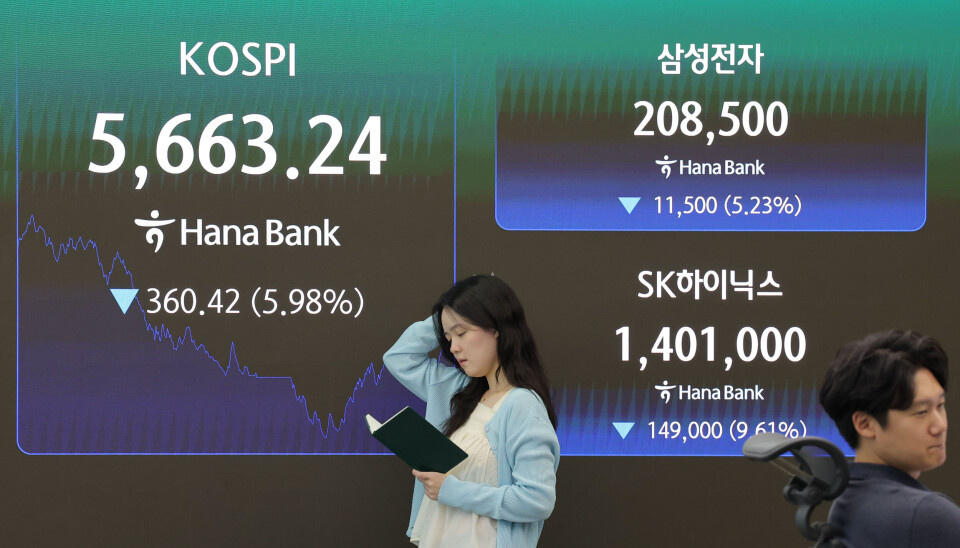
A screen displaying the Kospi index is seen at the trading room of Hana Bank's headquarters in central Seoul on the morning of July 31.YONHAP
Korean stocks rebounded sharply on Friday after U.S. semiconductor shares surged overnight and cut a weeklong losing streak, as concerns eased over AI profitability and the sustainability of Big Tech's heavy capital spending.
The benchmark Kospi stood at 6,381.66 as of 11 a.m. Friday, up 14.09 percent from the previous session, according to the Korea Exchange.
The index opened 1.15 percent higher, at 5,657.79, before extending its gains rapidly after the opening bell, soaring more than 10 percent during morning trading.
Samsung Electronics and SK hynix, which had plunged 27.21 percent and 18.5 percent, respectively, over the previous three trading sessions, led the rebound by jumping 20.53 percent and 25.42 percent.
Foreign investors drove the rally. They were net buyers of 4.86 trillion won ($3.38 billion) in the main Kospi market as of 11 a.m., while individual and institutional investors were net sellers of 4.46 trillion won and 274.4 billion won, respectively.
Among institutional investors, investment trusts and public pension funds purchased a net 200.3 billion won and 175.9 billion won, respectively, while financial investment firms sold a net 976.7 billion won.
Given that much of the selling by financial investment firms reflects retail orders placed through exchange-traded funds (ETF), market observers said many individual investors who suffered losses during the recent sell-off appeared to have taken advantage of the rebound to lock in gains or cut losses.
The Kosdaq also climbed to 699.20, up 8.44 percent, just short of reclaiming the 700-point mark.
Microsoft's logo at its offices in Issy-les-Moulineaux near Paris as seen on March 25, 2024.REUTERS/YONHAP
Surge of U.S. chip stocks
The sharp surge triggered buy-side sidecars in both the Kospi and Kosdaq markets at around 9:06 a.m., temporarily suspending the validity of program buy orders for five minutes.
The rebound followed a strong overnight performance by U.S. semiconductor stocks after Microsoft reported quarterly earnings that exceeded market expectations. Samsung Electronics also boosted sentiment during its earnings conference call Thursday, saying the global memory shortage is expected to deepen further next year.
Analysts explained that investor concerns over AI profitability eased after Microsoft reported strong growth in users of Microsoft 365 Copilot, its AI-powered productivity assistant.
Micron Technology surged 18.36 percent, SanDisk gained 25.99 percent, AMD climbed 13 percent and Intel rose 11.3 percent. The Philadelphia Semiconductor Index jumped 8.19 percent.
American depositary receipts of SK hynix, which had fallen sharply in recent sessions, rebounded 17.52 percent to close at $149. Overnight Kospi 200 futures also finished at their daily upper limit, up 8 percent.
A screen in Hana Bank's trading room in central Seoul shows the Kospi closing at 5,663.24 points on July 29, down 360.42 points, or 5.98 percent, from the previous trading session.YONHAP
Restoring confidence remains key
While Friday's rebound offered signs that market volatility may be easing, analysts stressed that restoring market confidence will be crucial to determining whether the rally can be sustained.
Friday marked the first day of tighter regulations on trading single-stock leveraged ETFs introduced by financial authorities.
Previously, investors needed a minimum deposit of 10 million won to trade single-stock leveraged and inverse ETFs. Beginning Friday, the minimum deposit requirement was raised to 30 million won. Substitute securities such as stocks, ETFs and bonds, which previously counted for up to 70 percent of the required deposit based on market value, are no longer eligible.
The Vkospi, the Kospi 200 volatility index often referred to as Korea's “fear gauge,” fell 2 percent to 84.46 as of 11 a.m.
The index had climbed above 90 during intraday trading on Wednesday. Its retreat to the mid-80s has raised hopes that market volatility may be beginning to ease, although analysts cautioned that it remains too early to conclude the rebound will be sustained.
A stock trading app displays the price chart of a Samsung Electronics single-stock leveraged exchange-traded fund on July 15.NEWS1
The Kospi had fallen 34.01 percent during July as of Thursday's close, marking its steepest monthly decline on record and exceeding the 27.24 percent drop recorded in October 1997 during the Asian financial crisis. The sharp sell-off also dealt a significant blow to retail investor sentiment.
“The Kospi could recover to the high-6,000 range sooner than many expect, but what comes after that is the real issue,” said Huh Jae-hwan, an analyst at Eugene Investment and Securities. “More important than selling pressure is restoring confidence in the market.”
Huh added that the government's stock market target was achieved faster than expected and corporate earnings improved rapidly, leading some investors to mistake a more favorable environment for stronger corporate fundamentals.
“Ultimately, what determines market flows is whether the market can continue creating new opportunities and whether companies have the financial strength to withstand difficult periods,” the analyst said.
This article was originally written in Korean and translated by a bilingual reporter with the help of generative AI tools. It was then edited by a native English-speaking editor. All AI-assisted translations are reviewed and refined by our newsroom.