Korea’s per capita income on track to top $40,000 for first time
The Bank of Korea says per capita gross national income is highly likely to exceed $40,000 this year, powered by a semiconductor earnings boom, improved trade terms and a stabilizing won.
Kim Hwa-yong, head of the Bank of Korea's national income department, speaks during a press briefing in Bank of Korea headquarters in Jung District, central Seoul, on Sept. 8.BANK OF KOREA
Korea’s gross national income (GNI) per capita is increasingly likely to surpass $40,000 for the first time this year, according to Bank of Korea (BOK) on Tuesday.
The BOK expects income gains that began in the chip industry to flow to households through bonuses and dividends before feeding into consumption and investment.
Nominal GNI in the second quarter jumped 8.8 percent from the previous quarter and 26.4 percent from a year earlier, according to preliminary national income data released by the central bank.
Nominal GNI measures national income at current prices and therefore reflects changes in prices. Real GNI also takes into account changes in the terms of trade, or the relative prices of exports and imports, to indicate how much more in goods and services the country’s income can actually buy.
Korea’s real GNI in the second quarter rose 3.1 percent on quarter, far outpacing the 0.6 percent growth in real GDP.
Real net factor income from abroad — income Koreans earned overseas minus income foreigners earned in Korea — fell to 7.9 trillion won ($5.87 billion) from 11.6 trillion won. But real trading gains surged by nearly 20 trillion won to 58.5 trillion won from 38.7 trillion won as Korea’s terms of trade improved.
“The likelihood of Korea’s per capita GNI exceeding $40,000 for this year is now very high, provided there are no unexpected shocks during the rest of the year, annual nominal GNI growth maintains its current pace and the exchange rate remains stable,” Kim Hwa-yong, head of the national income division at the BOK said at a press briefing on Tuesday.
Korea’s annual per capita GNI is calculated in won and converted into dollars using the average dollar-won exchange rate for the year. A stronger won against the dollar therefore raises the dollar-denominated figure.
A person holds bundles of dollars at Hana Bank in central Seoul on Aug. 5.NEWS1
Nominal GDP rose even faster. In the second quarter, nominal GDP increased 9.2 percent from the previous quarter and 26.4 percent from a year earlier. The 26.4 percent on-year increase was the strongest since the third quarter of 1979, when nominal GDP rose 27.7 percent from a year earlier.
The GDP deflator for the second quarter rose 21.9 percent from the previous year. The indicator tracks changes in the prices of all goods and services produced domestically, including exports and investment goods, rather than consumer prices alone.
Gross operating surplus in the second quarter rose 18.5 percent from the previous quarter, the largest on-quarter increase since data was first published in 2010.
The earnings boom is also spreading beyond semiconductors.
“Operating profits in semiconductor manufacturing rose sharply, and the improvement in earnings is gradually spreading to chemical products, transport equipment manufacturing and service industries such as wholesale and retail,” Kim said.
Samsung Electronics, left, and SK hynixYONHAP
Spending failed to keep pace with income growth, as the savings rate reached an all-time high. Korea’s gross saving rate reached 45.6 percent in the second quarter, up 3.9 percentage points from the previous quarter, the highest since the data series began in 1970. The household net saving rate was 9.7 percent in the second quarter, up from 8.8 percent in the first quarter.
The BOK found the figures suggest that much of the recent income increase had yet to flow into consumption and investment as of the second quarter, which leaves room for stronger domestic demand later in the year.
“The increase in gross operating surplus from strong corporate earnings is transferred to household income through bonuses and dividends and to government income through corporate, earned-income and dividend-income taxes,” Kim said. “That will translate into stronger domestic demand after a time lag.”
The central bank expects the transfer of corporate income to households and the government to become more visible in the second half of this year through dividends from companies such as Samsung Electronics and related tax payments.
The broader economy also maintained its growth momentum. Real GDP grew 0.6 percent in the second quarter from the previous quarter, unchanged from the advance estimate.
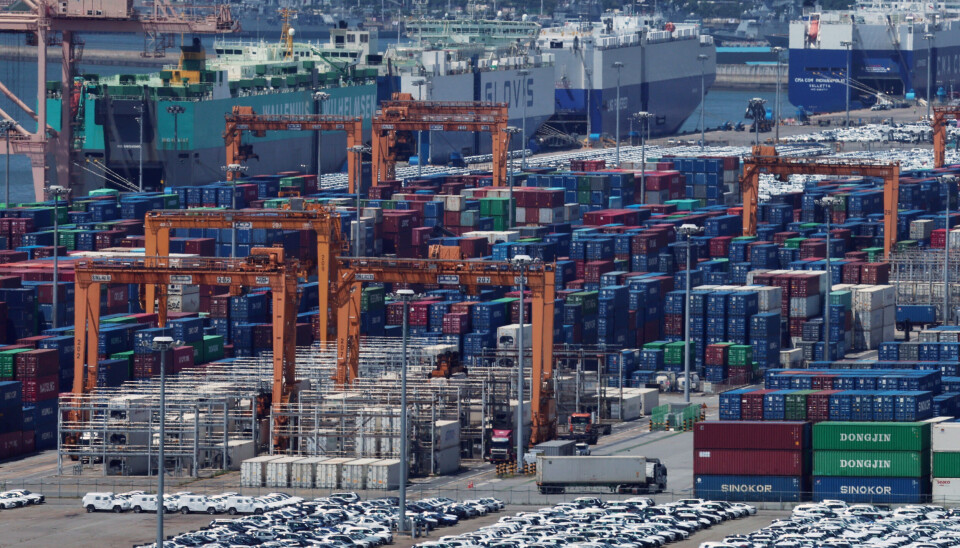
Containers for exports and imports are piled up at the Pyeongtaek Port in Gyeonggi on Aug. 11.NEWS1
Second quarter exports for the year rose 1.3 percent from the previous quarter, led by semiconductors and machinery and equipment, while private consumption increased 0.4 percent on quarter, led by spending on home appliances, restaurants and accommodation.
Net exports and domestic demand each added 0.3 percentage points to second quarter GDP growth.
The BOK estimates that Korea can meet its 3.3 percent growth forecast for 2026 if quarterly GDP growth averages 0.2 to 0.3 percent during the second half of the year.
Whether Korea can remain above $40,000 in per capita GNI after crossing the threshold is less certain. Dollar-denominated per capita GNI depends not only on economic growth but also on the exchange rate. Japan had previously exceeded $40,000, but economic stagnation and a weaker yen has pushed the figure back into the $30,000 range since 2024.
Korea could face the same risk if the semiconductor boom loses momentum or the won weakens sharply.
This article was originally written in Korean and translated by a bilingual reporter with the help of generative AI tools. It was then edited by a native English-speaking editor. All AI-assisted translations are reviewed and refined by our newsroom.