Korea’s KF-21 jostles with Russian, European rivals for fighter jet deals
Malaysia is weighing the purchase of up to 30 Boramae fighter jets as Korea’s homegrown aircraft, looking for its first export order, also draws interest from the UAE, Indonesia and the Philippines.
The first mass-produced KF-21 Boramae fighter conducts a test flight at the Air Force's 3rd Flying Training Wing in Sacheon, South Gyeongsang, on June 15.YONHAP
[NEWS ANALYSIS]
Malaysia is weighing the purchase of the KF-21 Boramae, pitting Korea's first homegrown supersonic fighter against rivals from Russia.
A Hyundai Motor Securities report dated June 19 assessed that the jet, developed by Korea Aerospace Industries (KAI),is moving beyond prototype development into its full export phase, with Malaysia now among four countries reviewing it, alongside Indonesia, the United Arab Emirates (UAE) and the Philippines.
GoogleAdmanager-KJD
None of the four has signed a formal purchase contract, but Indonesia is the furthest along. The same Hyundai Motor Securities report assessed that negotiations with Indonesia for 16 aircraft have entered their final stage, with the contract estimated at about 3 trillion won ($1.94 billion). That single deal, if signed, would fill roughly 30 percent of KAI's 10.44 trillion won order target for the year. The cluster of interest marks a shift for a jet that critics once said had failed to sell a single unit, and that is now simultaneously drawing attention across Southeast Asia and the Middle East.
Malaysia is reviewing the jet in connection with replacing its aging fighters, and while local reports cite a possible 30-aircraft requirement, it has not yet been formalized into an official program.
The KF-21 would not have the field to itself, however. Malaysia's interest is tied to its Multi-Role Combat Aircraft program, a long-planned effort to replace its aging F/A-18D Hornet and Su-30MKM fleets as they near retirement between 2035 and 2040, in what could amount to as many as 36 jets across two squadrons.
Recent reporting has cast the contest mainly as a race between the KF-21 and Russia's Sukhoi Su-57E, while the Western jets featured in Malaysia's earlier, shelved fighter rounds — Dassault's Rafale, Saab's Gripen, the Eurofighter Typhoon and Boeing's F/A-18E/F Super Hornet — are expected to remain in the broader conversation.
Korea's sales pitch rests partly on continuity, since Malaysia has already chosen the KAI-built FA-50, ordering 18 of the light combat jets in a $920 million deal in 2023, with first deliveries due later this year. Turkey has also been expanding its offerings in the same market, though one tier down, displaying its TAI Hurjet, a trainer and light-combat jet in the FA-50 class, at Kuala Lumpur's DSA 2026 exhibition in April, where Prime Minister Anwar Ibrahim signed for a full-scale model.
The momentum reflects a change in the KF-21's status. The aircraft completed its development flight testing earlier this year and entered mass production, with the first production jet rolling out in March and initial deliveries to the Korean Air Force due in the second half of the year. That moves it out of the development risk category that made some buyers hesitate. The KAI, meanwhile, set a 2026 revenue target of about 5.73 trillion won, up sharply from a year earlier, alongside an order target of 10.44 trillion won, and issued 500 billion won in convertible bonds to fund the production ramp-up.
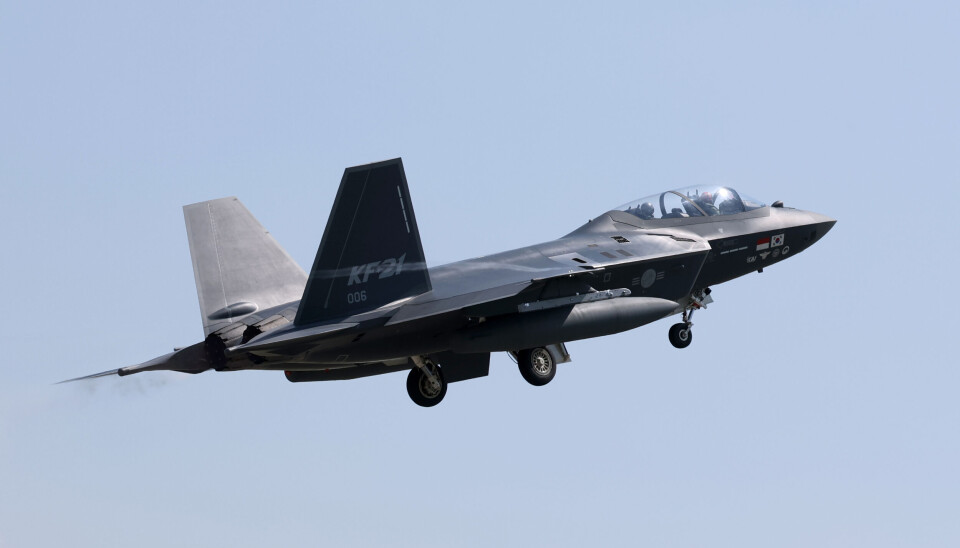
A prototype of the domestically developed KF-21 supersonic fighter jet takes off from the Air Force's 3rd Flying Training Wing in Sacheon, South Gyeongsang, on May 13.NEWS1
Indonesia is the linchpin of this strategy because it is the KF-21's only co-development partner. It originally agreed to pay about 20 percent of the development cost, roughly 1.7 trillion won, and to acquire up to 48 aircraft, with local production of about 50 additional jets.
The partnership faltered when Indonesia delayed its payments, and the two sides later cut Jakarta's contribution to about 600 billion won, which was confirmed that Indonesia paid in full last Thursday. Indonesia then shifted its plan from 48 Block 1 jets to 16 Block 2 jets, a scope it judged more affordable given the revised contribution and available export financing.
Korea is now adjusting the scope of technology transfer to match the smaller payment and is considering handing over one KF-21 prototype to Indonesia, with state-owned manufacturer PTDI possibly taking part in production or assembly. The 16-jet plan was discussed intensively around Indonesian President Prabowo Subianto's visit to Korea this year. A signed contract would give the KF-21 its first foreign customer.
Indonesia is also where Korea faces its sharpest export rivalry. Even as Jakarta negotiates for the KF-21, it signed a roughly $10 billion deal with Turkey in 2025 for 48 of its KAAN fifth-generation fighters, a sign that Indonesia is hedging its bets across multiple suppliers rather than committing to a single partner.
The other three prospects remain at earlier stages. The UAE has shown interest in a long-term cooperation model that would include joint development and local production rather than a simple purchase, and the two countries signed a letter of intent on fighter cooperation last year and have continued discussions since. The Philippines is reviewing the KF-21 as a multirole candidate in its air force modernization, and already operates Korea's FA-50, which gives it continuity in operations and maintenance.
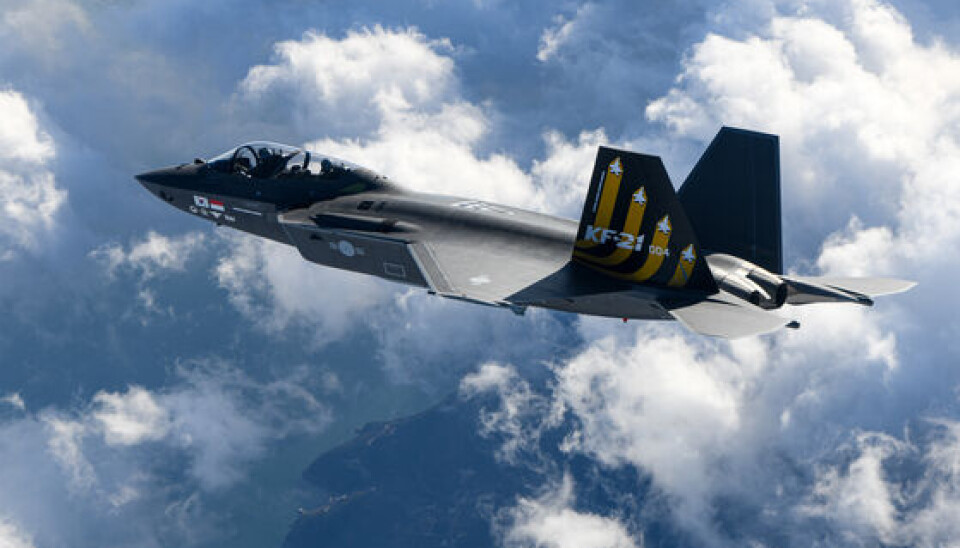
Korea's homegrown fighter jet, the KF-21 Boramae, is seen during a test flight on Nov. 29, 2024.NEWS1
Even so, analysts caution that fighter exports take time. "KF-21 exports need to be approached with a long-term outlook, in principle," said Jang Won-joon, an associate professor specializing in the defense industry at Jeonbuk National University. "Just as France's Rafale took more than 10 years to reach its first export, a fighter sale comes together only when performance, operational reliability, follow-on support, financing terms and diplomatic and security cooperation all line up."
But Jang said the timing could be pivotal. "Because the KF-21 is set for its first deployment this year, succeeding in a first export at this moment could be a watershed for K-defense exports," Jang said, adding that exporting an independently-developed fighter would mark Korea's rise as an advanced aviation defense country after years of growth built around ground weapons, ships and trainer jets.
Prof. Jang said the immediate priority should be securing the fighter jet's first sale. "The most important thing is to establish a reference through the first export, and in that respect there is a need to focus first on completing the export to Indonesia," he said.
None of the four countries has committed. Future sales will turn not only on price but on local production, technology cooperation, financing and long-term logistics support, the same conditions that have shaped every recent K-defense deal.
The KF-21's first export order still remains unsigned. But for a jet that skeptics once said had failed to sell, the fact that four simultaneous conversations are taking place with potential buyers marks a clear change in its trajectory.