Korea's foreign reserves rise in June despite market-stabilizing measures

The Bank of Korea attributed the monthly increase to a rise in foreign currency-denominated deposits by financial institutions.

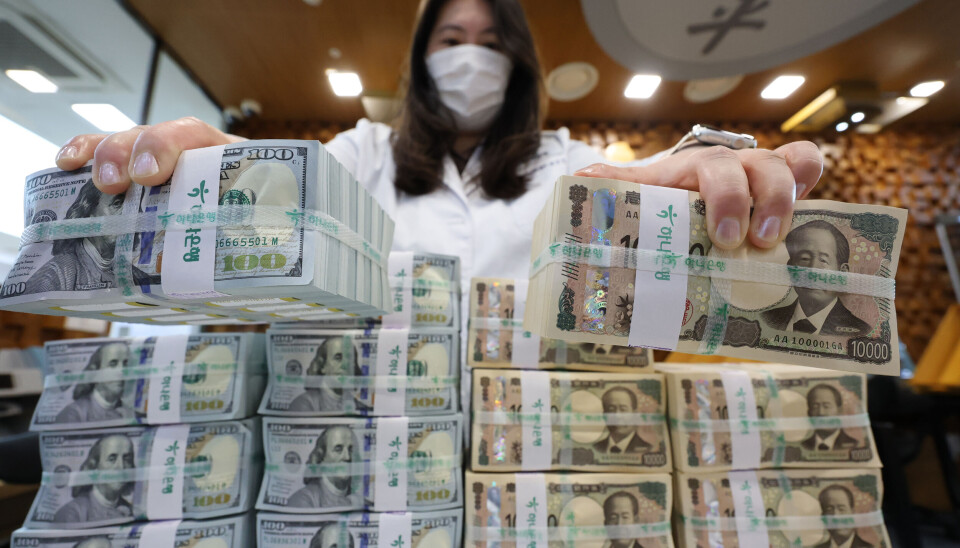
An employee holds up dollar and yen bills at Hana Bank's counterfeit notes response center in Jung District, central Seoul, on July 2.

Korea's foreign reserves rose in June despite efforts by authorities to manage exchange rate volatility, the central bank said on Friday.

The country's foreign reserves stood at $427.36 billion as of the end of June, up $370 million from a month earlier, according to data from the Bank of Korea (BOK).

The figure marked a turnaround from an $880 million decline in May.

The BOK attributed the monthly increase to a rise in foreign currency-denominated deposits by financial institutions despite market stabilization measures, such as foreign exchange swaps with the National Pension Service.

The won has traded over the psychologically important level of 1,500 won against the dollar throughout June due to net selling of local stocks by foreign investors.

It dropped to 1,549.4 won per dollar on the last day of June, marking the weakest level since March 6, 2009.

Foreign securities, including U.S. Treasuries, fell by $330 million from a month earlier to $380.34 billion at the end of June, accounting for 89 percent of the country's total foreign reserves.

The value of foreign currency deposits rose $920 million to $22.27 billion, while special drawing rights decreased $140 million to $15.64 billion.

Gold bullion holdings remained unchanged at $4.79 billion.

The country's reserve position with the International Monetary Fund decreased by $90 million from a month earlier to $4.31 billion at the end of June, the latest findings showed.

Korea ranked as the world's 13th-largest holder of foreign reserves as of the end of May, down from 12th place a month earlier.

China topped the list, followed by Japan, Switzerland, Russia and India, according to the BOK.


Yonhap