Hyundai targets growth in Brazil with localized vehicles and hydrogen
The automaker plans to ramp up productivity in the South American country with flexible-fuel hybrid manufacturing and hydrogen projects as Chinese rivals gain ground.
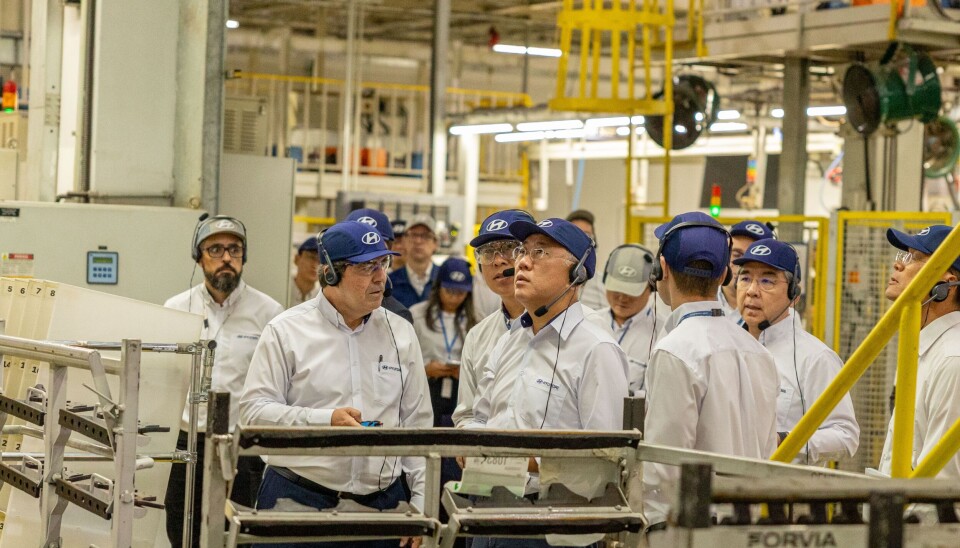
Hyundai Motor Group Executive Chair Euisun Chung, center, inspects the automaker's factory in São Paulo, Brazil, on July 27.HYUNDAI MOTOR GROUP
Hyundai Motor Group unveiled a road map to deepen its presence in Brazil that spans localized vehicle production, hydrogen mobility and green energy projects, the Korean automaker said Thursday.
"Brazil's changing industrial landscape and the emergence of new competitors present us with significant challenges," Hyundai Motor Group Executive Chair Euisun Chung said during his visit to the automaker's São Paulo plant on Monday. Chung was accompanying President Lee Jae Myung on his state visit to the South American country as part of a business delegation.
"But overcoming this crisis is essential if we are to take the next step forward. We need to strengthen our research and development capabilities in Brazil and accelerate the localization of our powertrains.”
Chung’s remarks underscored Hyundai's determination to defend its position in Latin America as Chinese automakers rapidly expand their footprint in Brazil. Chinese carmakers have been building factories across Latin America, including Brazil, to sidestep U.S. tariffs while expanding their presence in the broader Americas market.
Chinese investment in Brazil reached $6.1 billion last year, up 45 percent from a year earlier, according to the China-Brazil Business Council. BYD, in particular, began production last year after acquiring a former Ford plant. It rose from eighth place in Brazil's auto market last year to fourth in the first half of this year.
Hyundai, by contrast, slipped to fifth in the January-to-June period this year. The Korean automaker ranked fourth in 2020.
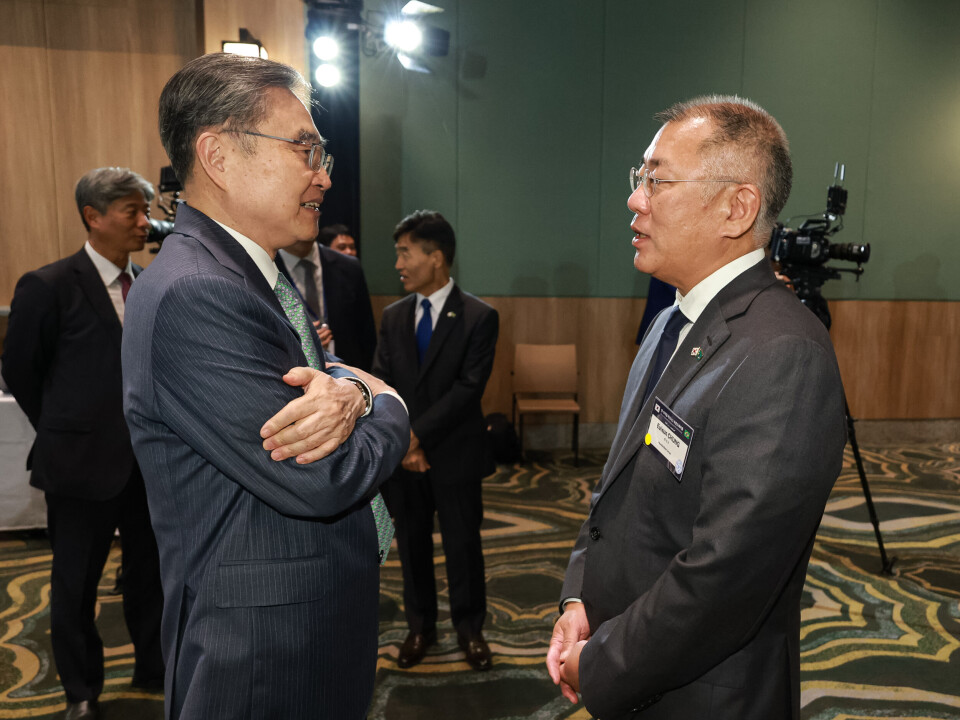
Hyundai Motor Group Executive Chair Euisun Chung, right, speaks with Foreign Minister Cho Hyun during a roundtable held in São Paulo, Brazil, on July 28.NEWS1
Brazil is the world's sixth-largest automobile market, with annual demand of about 2.5 million vehicles, and the eighth-largest vehicle producer, manufacturing roughly 2.6 million vehicles a year.
The country also holds around 20 percent of the world's graphite reserves and the second-largest rare earth reserves. Its vast mineral wealth has also elevated its role in global supply chains for EV batteries and renewable energy.
For Hyundai, Brazil remains its most important foothold in Latin America. Hyundai Motor Brazil's plant, completed in 2012, produces 200,000 vehicles annually for the local market, and the group's Central and South American headquarters is also located in the country.
During the visit, Chung inspected the plant's regional research and development center as well as its production lines.
The facility manufactures about 200,000 vehicles a year, including the locally specialized HB20 compact car, the Creta SUV and the i20. Chung paid particular attention to production quality for the i20, which entered production last month, and the Creta, one of Hyundai's flagship models in the Brazilian market.
Hyundai Motor Group Executive Chair Euisun Chung, center in front row, inspects the automaker's factory in São Paulo, Brazil, on July 27.HYUNDAI MOTOR GROUP
"The achievement of producing 2.5 million vehicles in just 13 years is the result of the dedication and teamwork of everyone at the Brazil plant," Chung said.
Hyundai sold 96,723 vehicles in the South American nation during the first half of this year and aims to raise sales for a calendar year to 204,000 units, according to Fenabrave, Brazil’s national federation for distribution of automobile vehicles.
To achieve that goal, the company plans to broaden its SUV lineup and introduce more environmentally friendly vehicles tailored to local demand. It aims to pursue the long-term development of a hydrogen business in Brazil.
Brazil imposes a 35 percent tariff on imported green vehicles, which renders cars made abroad less competitive. Hyundai is considering local production of compact EVs while stepping up development of a gasoline-ethanol flexible-fuel hybrid powertrain.
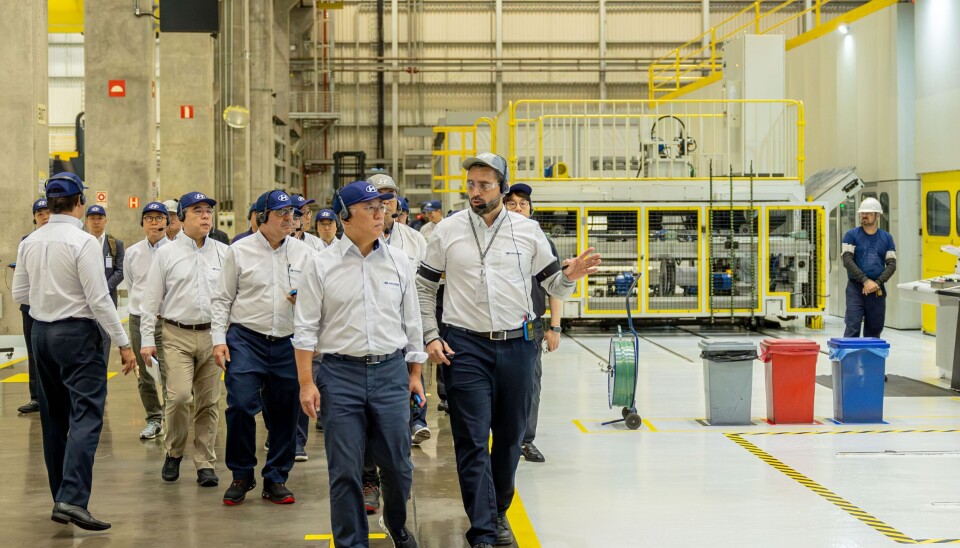
Hyundai Motor Group Executive Chair Euisun Chung, left in front row, inspects the automaker's factory in São Paulo, Brazil, on July 27.HYUNDAI MOTOR GROUP
The Korean automaker also plans to contribute to the country's hydrogen and renewable energy ecosystem.
Brazil, a regional leader in renewable energy, actively fosters industrial foundations for low-carbon hydrogen production. It also exports its yields through the National Hydrogen Program. Hyundai Motor Groupcanprovide integrated solutions spanning the entire hydrogen value chain, from production and distribution to end-use.
Hyundai and its affiliates plan to build new hydrogen mobility businesses centered on hydrogen-powered commercial vehicles and trams, while investing in green hydrogen production, fuel cell systems and power plant construction for renewable energy.
This article was originally written in Korean and translated by a bilingual reporter with the help of generative AI tools. It was then edited by a native English-speaking editor. All AI-assisted translations are reviewed and refined by our newsroom.