Hanwha offered the world in its failed Canada submarine bid. Will that hurt Korea in future arms deals?
Despite a lavish offer, Korea’s failed bid exposed how NATO politics, product fit and negotiating strategy can outweigh technology in major defense deals.
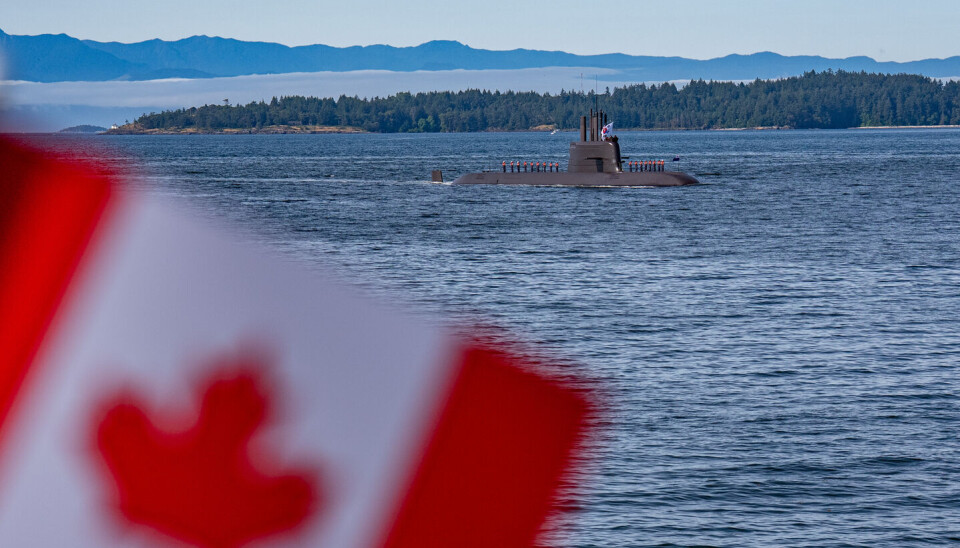
The KSS-III Dosan Ahn Chang-ho submarine arrives at Canadian Forces Base Esquimalt in Victoria, British Columbia, on May 23 to participate in a Korea-Canada joint naval exercise.REPUBLIC OF KOREA NAVY
[NEWS ANALYSIS]
Korea's bid for Canada's 60 billion Canadian dollar ($42.3 billion) submarine program came loaded with sweeteners, including some 70 billion Canadian dollars in projected economic effects, tens of thousands of jobs a year and investment stretching from Ontario steel to rocket technology.
GoogleAdmanager-KJD
Korea still lost. And the richness of the losing bid may itself become a burden, according to industry officials.
"Future customers now know what Korea is willing to put on the table," said a source in the local shipbuilding industry. "They will open negotiations there. The precedent was set in a deal Korea didn't even win."
The concern is not limited to prospective buyers. Countries that have already signed with Korea, such as Poland, may also return to the table asking for more, the official said.
Prime Minister Kim Min-seok speaks with Canadian Prime Minister Mark Carney as they tour the Hanwha Ocean Shipyard in Geoje Island, South Gyeongsang, on Oct. 30, 2025.AP/YONHAP
What Korea put on the table
Prime Minister Mark Carney announced at the Halifax naval base on July 6 that Germany's TKMS had been selected as the preferred bidder for the Canadian Patrol Submarine Project, calling it a very difficult and close choice and stressing that both platforms met the Royal Canadian Navy's requirements.
The package Korea assembled went far beyond the boats themselves. Hanwha Ocean, bidding as one team with HD Hyundai Heavy Industries, projected roughly 70 billion Canadian dollars in economic effects and, according to an analysis Hanwha commissioned from consulting group KPMG, over 22,000 jobs a year through 2044.
The offer included a 345 million Canadian dollar investment in Ontario steelmaker Algoma Steel, a joint venture with Canada's auto parts industry to produce vehicles locally, cooperation on rocket launch technology and a defense innovation center involving dozens of Canadian partner firms.
Korea also promised speed, a first boat by 2032 and all 12 by 2043, and sailed the in-service submarine Dosan An Chang-ho 14,000 kilometers (8,700 miles) to Canada to prove the product already exists.
The KSS-III Batch-II submarine, built by Hanwha Ocean. The Korean shipbuilder has been shortlisted as a final contender for Canada’s $44 billion Canadian Patrol Submarine Project to replace the Royal Canadian Navy's aging Victoria-class fleet.HANWHA OCEAN
Exception vs benchmark
Whether that generosity becomes the going rate is now debated among the experts who watched the race.
Yoo Hyon-joo, a professor of political science and international relations at Hankuk University of Foreign Studies, does not share the industry's worry.
"I wouldn't go that far," she said. The decision, in her view, was the natural product of a security relationship between two NATO countries that is fundamentally deeper than anything Korea and Canada have built, where cooperation such as intelligence sharing has only recently begun expanding.
"It's possible that, in the short term, we've raised expectations somewhat," Yoo said. "But from a medium- to long-term perspective, what's much more important is the relationship and trust that have been built over time. Whether we offer additional industrial cooperation packages or not is, in my opinion, a secondary issue."
Jo Dong-Joon, a professor in the Department of Political Science and International Relations at Seoul National University, argued that Canada should be viewed as an exceptional case rather than a template. Korea has always sold weapons bilaterally, he said, but this bid was different.
"Winning the Canadian deal was not simply about selling submarines to Canada,” Jo said. “It was about gaining access to the broader network that Germany is building. Because of that possibility, Korea was willing to offer much more favorable conditions."
Most European countries are not integrated into that German-centered network and "should still be viewed as individual bilateral relationships," he said. Asked whether the Canadian package would haunt future negotiations, Jo was direct. "I don't think it will become a significant problem."
Canada’s Prime Minister Mark Carney announces that Canada has picked Germany’s TKMS to build 12 submarines for its navy at the HMC Dockyard in Halifax, Nova Scotia, Canada, on July 6.REUTERS/YONHAP
The NATO tiebreaker
The debate over the precedent rests on why Korea lost, and there the experts largely agree. The tiebreakers Carney cited were alliance ones. TKMS supplies roughly a third of NATO members' submarines, and its offer to reallocate German and Norwegian production slots would deliver Canada's first four boats by 2034.
Hanwha Ocean, named the reserve supplier should negotiations collapse, said in a statement that it could not overcome "the wall of the NATO alliance."
"In terms of technology, performance and MRO capabilities, Korea was not significantly behind,” said Prof. Jang Won-joon of Jeonbuk National University's defense industry convergence program. “We were broadly on par, and in some areas we were actually ahead.”
With Canada's defense relationship with the United States growing uncertain, Jang said, Ottawa's strategy was to bind itself to stronger alliance partners, and it chose to deepen cooperation with NATO rather than with Korea.
"Simply put, we ran into the wall of the Atlantic alliance once again," said Choi Gi-il, professor of military studies at Sangji University and director of the Korea Defense Industry Research Institute. "It's not that we lost because we were inferior. In many ways, it was a full-scale national competition between Germany and Korea."
Choi offered the line circulating among military experts as consolation. "Korean submarines are in the ocean, while German submarines are still on the drawing board."
The KSS-III Dosan Ahn Chang-ho submarine arrives at Canadian Forces Base Esquimalt in Victoria, British Columbia, on May 23 to participate in a Korea-Canada joint naval exercise.REPUBLIC OF KOREA NAVY
Not everyone believes the product was blameless. Jo argued that the submarine Korea offered was also mismatched to Canadian doctrine.
"Canada's defense policy focuses on using submarines as a deterrent and a training platform," he said, noting that Ottawa even removed anti-ship missiles from its Victoria-class boats to hold them to close-range combat. The submarine class that Korea proposed, armed with vertical launch tubes for Hyunmoo ballistic and cruise missiles, is a different animal.
"To use an air force analogy, the KSS-III Batch II is a strategic bomber," Jo said. "Its offensive power is enormous, but it is vulnerable in defense."
The German 212CD's fuel cell and lithium battery design "allows submergence of up to 41 days," against roughly 21 for the Korean boat, he added, and it runs a combat system built by a German-Norwegian venture to NATO data-link standards while the Korean vessel runs an indigenous one.
A door left ajar
Hopes that the reserve supplier designation keeps Korea in the running drew cold water. Asked the odds that Canada's negotiations with TKMS fail, Jang put the chance the deal goes through at about 99 percent, calling any reversal unrealistic.
Choi redirected the hope forward instead. Germany's victory ties up its production capacity for years, he argued, and the 212CD has never been built. "Markets larger than Canada are still waiting for us," he said, predicting Germany will be unable to chase every coming submarine competition with 12 Canadian boats on its books.
The industry source who raised the precedent concern fundamentally agreed, saying TKMS will now focus on Canada rather than the rest of the European market, effectively leaving more room in Europe for Korea.
Jacek Cyrek, President and CEO of Hanwha Aerospace Europe, speaking at the NATO Defence Industry Forum panel session in Ankara, Turkey, on the sidelines of the NATO Summit on July 8.HANWHA AEROSPACE
The homework
The prescriptions differ. Jang's is institutional. Korea should accelerate a formal Korea-NATO defense cooperation agreement, he said, with a dedicated task force covering local production, joint development, supply chains and export financing, concluded by year-end or early next year if possible.
"From NATO's perspective, Korea needs to be seen not as an outside country but as a genuine strategic partner," Jang said.
Choi's is operational. Germany worked Canada for years while Korea engaged seriously only in the final stretch, he said. "We weren't just one step late. We were two or three steps late." He also faulted the publicity, saying no other exporter advertises campaigns in progress while Korean officials and media discussed the Canadian program almost as if it were already won.
Yoo's is patience. European militaries prize interoperability proven through joint exercises Korea rarely joins, she said, the same logic that once led Korea itself to choose American equipment. "If we're willing to invest over the next 10 or 20 years, I think the possibility certainly exists."
None of it amounts to regret over the bid itself. "I'm not saying Korea's defense export strategy or package deals were wrong," Choi said. "We did everything right. We simply fought well and lost."
“Technology delivers its greatest value when it is built on trust, shared purpose and strong partnerships,” said Jacek Cyrek, President and CEO of Hanwha Aerospace Europe, on Tuesday at the NATO Defence Industry Forum panel session in Ankara, Turkey, on the sidelines of the NATO Summit. “We are committed to strengthening sovereign capabilities, fostering industrial cooperation, and contributing to a stronger and more resilient NATO ecosystem.”