Government lifts growth outlook to 3% on export surge, megaproject investments
Seoul sharply raised its 2026 growth forecast on booming semiconductor exports and megaproject investment, while warning that inflation, a weak won and Middle East tensions still threaten the outlook.
Containers are stacked at Pyeongtaek Port in Pyeongtaek, Gyeonggi, on July 1.YONHAP
The government sharply raised the economic growth forecast for this year to 3 percent, citing a semiconductor-driven export boom and stronger capital investment fueled by three large-scale national projects.
Despite the improved outlook, persistent inflation, a weak won and high interest rates remain key challenges, while renewed instability in the Middle East could undermine the optimistic forecast.
The government raised its forecast for real GDP growth this year to 3 percent from 2 percent on Tuesday as it unveiled its economic strategy for the second half of the year.
The nominal GDP growth forecast, which includes inflation, was raised to 12.3 percent, jumping from the previous 4.9 percent forecast. If realized, the figure would mark the highest level since 1996, when nominal GDP growth reached 12.3 percent. The revision stems from a sharp increase in export prices, driven by rising semiconductor prices.
The stronger growth outlook was also reflected in fiscal indicators. The government now expects the country's debt-to-GDP ratio to fall to 47 percent this year, compared to its previous forecast of 50.6 percent. Gross national income (GNI) per capita is projected to approach $40,000, though whether that target can be reached will depend on the dollar-won exchange rate movement in the second half of the year.
The government's 3 percent growth forecast is well above projections from major domestic and international institutions. The International Monetary Fund, Organisation for Economic Cooperation and Development and the Bank of Korea (BOK) all forecast a 2.6 percent growth.
The government bases the forecast on strong export performance. Korea's cumulative exports reached a record $496.7 billion this year through June, up 48.4 percent a year earlier. Semiconductor exports alone surged 163 percent on year during the same period. Strong exports helped Korea rank as the world's fifth-largest exporter based on figures this year through April, overtaking Japan and Italy. The current account surplus also reached $141.3 billion this year through May, already surpassing the previous annual record of $123.1 billion set last year. The government expects the surplus to reach $290 billion for the overall year.
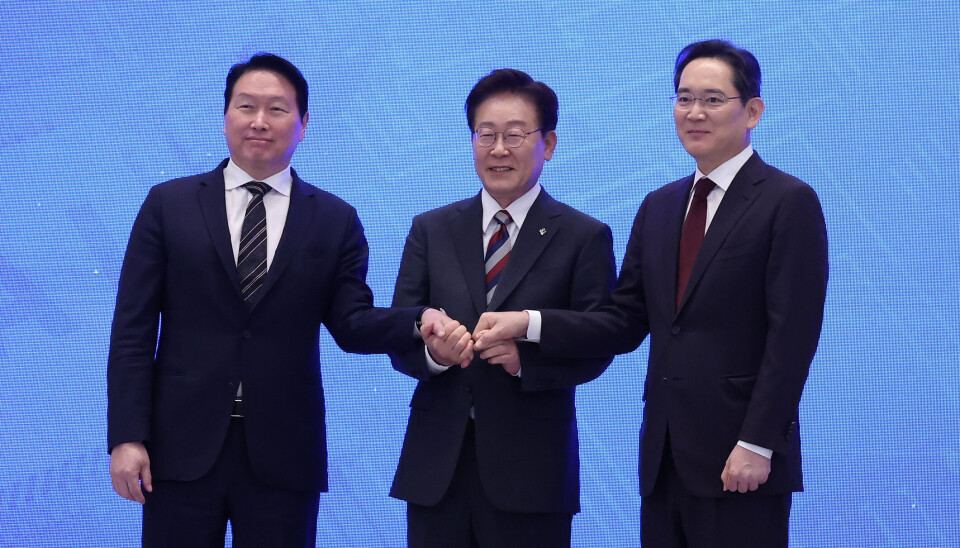
The government also significantly raised its investment outlook. It revised its forecast for facility investment growth to 5 percent from the previous 2.1 percent, reflecting the launch of three so-called megaprojects in semiconductors, data centers and physical AI. A combined investment of 957 trillion won ($643 billion) will be made for the three projects.
From left, SK Group Chairman Chey Tae-won, President Lee Jae Myung, and Samsung Electronics Executive Chairman Lee Jae-yong join hands after $520 billion investments for four new chip plants at the Blue House in Jongno District, central Seoul, on June 29.JOINT PRESS CORPS
“We took into account that companies are moving up their investments amid the semiconductor boom,” First Vice Finance Minister Lee Hyoung-il said.
Private consumption and construction investment are expected to grow just 2 percent and 0.2 percent, respectively, suggesting that the gap between exports and domestic demand remains wide.
Employment outlook likewise remains grim. It revised its forecast for the increase in the number of employed people this year to 150,000 from the previous 160,000.
“The semiconductor industry is a capital-intensive sector and does not generate a particularly large employment effect, and we took a more conservative view than other institutions given the difficult situation for a substantial increase in employment during the second half,” a Finance Ministry official said.
Significant uncertainties remain despite stronger economic outlook. It identified heightened financial market volatility and possible interest rate hikes as the biggest risks in the second half.
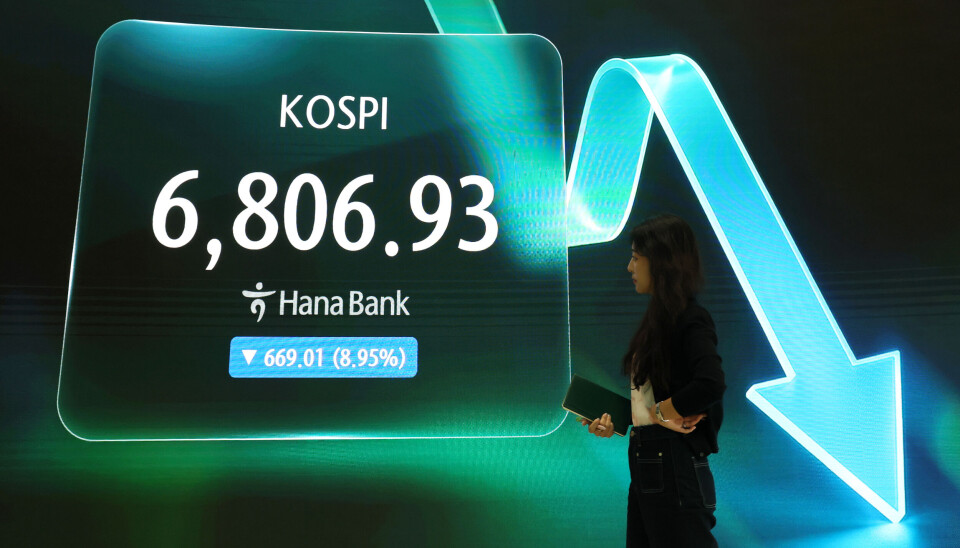
A screen in Hana Bank's trading room in central Seoul shows the Kospi closing at 6,806.93 points on July 13, down 669.01 points, or 8.95 percent, from the previous trading session.YONHAP
Recent sharp gains in the stock market have increased demand among foreign investors to rebalance their Korean equity holdings, with exchange rate volatility growing. There is a high possibility that the BOK could raise interest rates this month, which could put additional burden on small business owners and heavily indebted borrowers as inflation and a weakening won persist.
In Tuesday's economic forecast, the government said risks from the Iran war had eased somewhat, citing negotiations then underway between the United States and Iran to end the conflict. However, things have rapidly changed. Iran reportedly re-closed of the Strait of Hormuz and the United States reinstated airstrikes on Iran, which heightened regional tensions again. Whether the government's upbeat forecast will be realized will depend on how domestic and external conditions evolve in the second half.
The government also presented a medium- to long-term vision the same day. It aims to raise Korea's potential growth rate to 3 percent, make the country the world's fourth-largest exporter and increase GNI per capita to $50,000. It did not specify a target year for achieving those goals but emphasized its determination to make 2026 the first year of a rebound in Korea's potential growth rate.
“There is a precedent from the late 1990s, when the United States made large-scale investments in the information technology sector, which boosted productivity across the economy and supported a growth rebound,” First Vice Finance Minister Lee said. “We will move forward with confidence so that the opportunity created by the semiconductor boom can spread into a wide range of industries, including AI, automobiles and defense.”
This article was originally written in Korean and translated by a bilingual reporter with the help of generative AI tools. It was then edited by a native English-speaking editor. All AI-assisted translations are reviewed and refined by our newsroom.