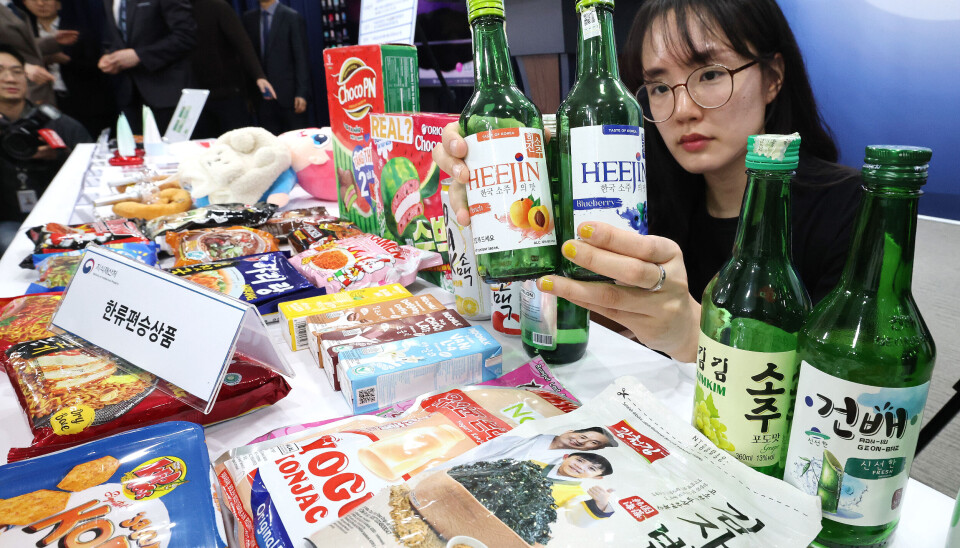
An official from the Ministry of Intellectual Property displays copycat products of Korean food, beverage and cosmetics products during a press briefing in Jongno District, central Seoul, on March 31.NEWS1
A surge in copycat K-beauty, K-fashion and K-food products is pushing the government into a joint crackdown to protect smaller exporters.
A council aimed at protecting the intellectual property (IP) of small and midsize enterprises will be launched by the Ministry of SMEs and Startups and the Ministry of IP. The two ministries are meeting on Friday to discuss further details.
Counterfeit products have proliferated along with the growing popularity of Korean culture and export-oriented SMEs are facing growing damage.
Copycat versions of Relief Sun, a popular sunscreen from the cosmetics brand Beauty of Joseon, have been sold on Amazon and TikTok Shop. The products mimic not only the packaging but also the price of the original product to avoid raising suspicion.
Relief Sun sunscreen from the Korean beauty brand Beauty of JoseonSCREEN CAPTURE
Products that copied the trademarks and packaging of well-known gim, or dried seaweed, brands have also surfaced in Indonesia. Not only that, the knockoffs registered trademarks in Indonesia, made knockoff products under the copycat names and exported the products to other countries.
A broker suspected of illegally distributing Chinese-made knockoff cosmetics in Korea was referred to prosecutors on Sept. 17, the Ministry of Food and Drug Safety and the IP Ministry said.
The broker has sold 4.5 billion won ($3.3 million) worth of cosmetics and health supplements on e-commerce platforms such as Coupang and Naver from October 2024 to November 2025.
The number of counterfeit K-brand products blocked on online shopping platforms worldwide rose from 160,000 in 2023 to 210,000 last year, according to the Korea Intellectual Property Protection Agency (Kippa).
An official from the Ministry of Intellectual Property holds up an authentic product, left, and a copycat product of Buldak Spicy Ramen at the Government Complex in Jongno District, central Seoul, on March 31.NEWS1
The SMEs Ministry and IP Ministry plan to regularly share information on copycat K-brands and coordinate responses through overseas support centers called Global Business Centers.
The centers are operated by the Korea SMEs and Startups Agency and have 22 locations in 14 countries, including New York; Tokyo; Beijing; Hanoi, Vietnam and Jakarta, Indonesia.
The SMEs Ministry also plans to link its export support programs with overseas IP protection programs so SMEs participating in export assistance projects can receive support in both areas.
The ministry will also hold briefings on the protection of IP rights overseas and responses to disputes.
The Korea SMEs and Startups Agency and Kippa plan to sign a memorandum of understanding to formalize the cooperation.
Customers shop at the Olive Young Central Myeongdong Town in central Seoul.OLIVE YOUNG
Individual companies are also stepping up efforts to stop counterfeit products from circulating.
AliExpress operates an AI-based detection system designed to identify suspected counterfeit goods. The platform removed 17 times as many counterfeit listings through its own monitoring as Korean rights holders reported, the company said on Monday.
Coupang held a brand protection seminar with the Korea Cosmetics Association and cosmetics brands on Sept. 13 as part of efforts to strengthen its response to counterfeits.
Coupang plans to operate dedicated hotlines for major brands so reports can be received and acted on even on weekends, public holidays and late at night.
This article was originally written in Korean and translated by a bilingual reporter with the help of generative AI tools. It was then edited by a native English-speaking editor. All AI-assisted translations are reviewed and refined by our newsroom.