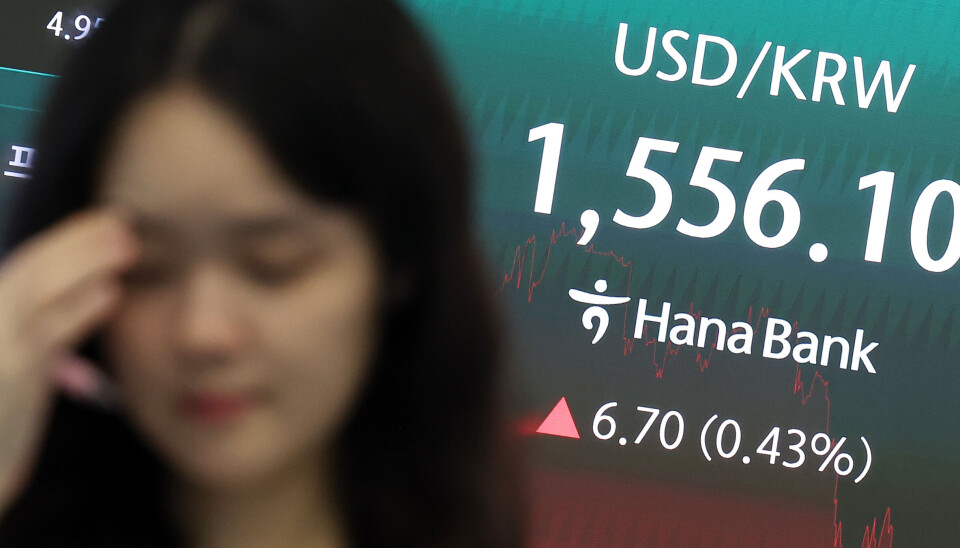
The dollar-won exchange rate is displayed on an electronic screen in Hana Bank's trading room in central Seoul on July 1.NEWS1
A record 148 trillion won ($95 billion) in net selling by foreign investors during the first half may not mark the end of the financial outflow from Korea. Brokerages believe the selling streak is likely to continue into the second half amid an elevatedKospi and a weakened won.
Foreign investors recorded net sales of 148.32 trillion won in the Kospi market between January and June, according to Yonhap Infomax on Wednesday.
Individual investors snapped up a net 99.17 trillion won worth of shares, while institutional investors purchased 35.05 trillion won.
On Monday, foreign investors posted a record-high daily net sell-off of 7.76 trillion won.
Brokerages attributed the sustained foreign selling primarily to profit-taking and portfolio rebalancing after the Kospi's sharp rally in the first half of the year.
With the benchmark index climbing 101.14 percent in the January-June period, Korean equities made up a larger share of global portfolios, which later led investors to trim their holdings.
The Kospi is seen closing at 8,411.21 on a screen at Hana Bank's trading room in central Seoul on June 26.NEWS1
The depreciating won also added to selling pressure, analysts said.
A stronger dollar tends to encourage foreign investors to reduce their Korean stock holdings to limit foreign-exchange losses.
Foreign investors have posted net sales of 92.89 trillion won over two months since May — when the weakening of the won against the dollar became more noticeable.
During the same period, the won depreciated by 66.1 won, from 1,483.3 won per dollar to 1,549.4 won based on the regular daytime session closing rate.
Brokerages said foreign investors are likely to remain net sellers for the time being as the Kospi's upward momentum and dollar strength are expected to persist into the second half.
At the same time, securities firms have been raising their Kospi targets on expectations of improving corporate earnings led by chipmakers.
Currency traders celebrate in front of a screen showing the Kospi crossing the 9,000-point level at the trading room at Hana Bank's headquarters in central Seoul on June 18.AP/YONHAP
Korea Investment & Securities and Samsung Securities lifted their upper-end targets to 11,000, while Daishin Securities projected the index could reach 11,500.
"It is difficult to expect foreign investors to return to net buying of Korean stocks in the second half," Moon Da-woon, an analyst at Korea Investment & Securities, said. "The selling is an inevitable reaction after the Kospi's rapid surge."
Foreign stock selling is still likely to outweigh purchases given their expected scale and timing despite anticipated capital inflows by SK hynix's planned American Depositary Receipt listing in the United States and Korea's inclusion in the FTSE World Government Bond Index, Moon added.
"The remaining potential selling pressure is estimated to exceed the volume that has already been sold," Oh Jae-young, a researcher at KB Securities, said.
"The dollar-won exchange rate could climb as high as 1,580 won per dollar in the second half amid continued dollar strength and foreign selling, although it is likely to move back into the 1,400-won range after the fourth quarter."
This article was originally written in Korean and translated by a bilingual reporter with the help of generative AI tools. It was then edited by a native English-speaking editor. All AI-assisted translations are reviewed and refined by our newsroom.