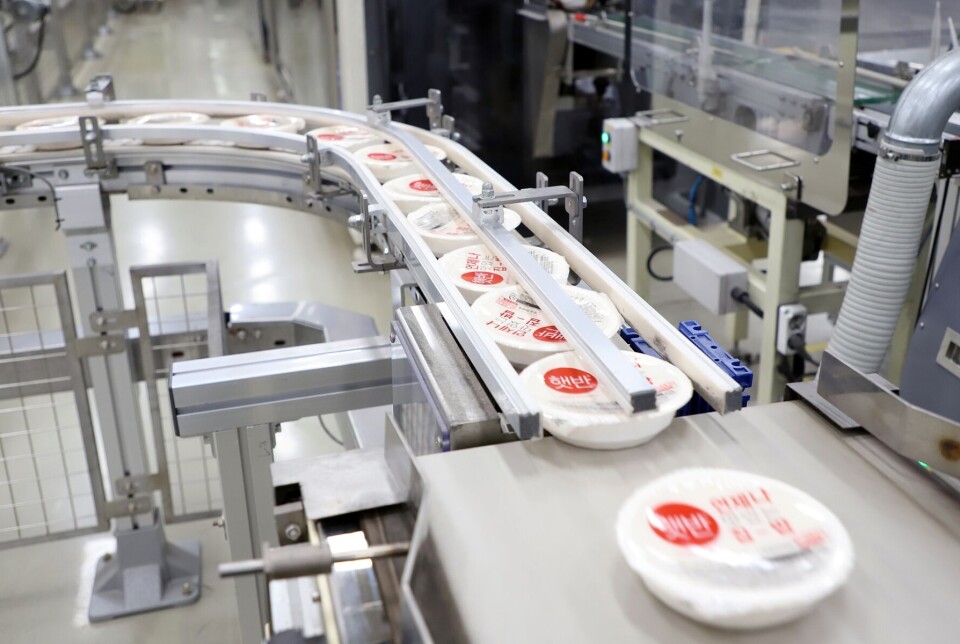
Hetbahn bowls are manufactured at a smart factory at CJ Blossom Campus in Jincheon, North Chungcheong, on Oct. 21.CJ CHEILJEDANG
CJ CheilJedang has set the annual sales target for its Hetbahn instant rice brand at over 1.5 trillion won ($1.13 billion) by 2028, counting on new multigrain products to drive growth as demand for plain white rice levels off.
That target is 36.4 percent higher than the 1.1 trillion won that the brand made in sales in 2025.
Both figures combine domestic and overseas sales at consumer prices.
The company announced the target at a media briefing in Jincheon, North Chungcheong, on Wednesday, marking the brand’s 30th anniversary.
Hetbahn launched in December 1996 as Korea’s first aseptically packaged cooked rice. The precooked rice is sealed in a microwavable tray that keeps at room temperature for nine months without preservatives.
Thirty years on, the brand’s domestic lead is narrowing. Hetbahn still holds 60 percent of Korea’s packaged rice market, according to Kim Jin, the global chief marketing officer at CJ CheilJedang, but she acknowledged that its share has slipped.
As a result, the company is building its plan around healthier rice.
“We don’t have a plan to run price promotions or lower our quality to raise our market share,” Kim said. “It’s less a fight over market share than a fight over how big we can make our slice of pie.”
That growth is coming from grains other than white rice.Korea’s packaged rice market is growing 5 percent annually, according to Kim, but that growth comes from grains other than white rice, with white rice up an annual average of 3 percent and multigrain rice 13 percent.
“I think that multigrain rice could reach the same level as white rice within about five years,” she said.
CJ’s next product goes a step further. In December, the company will release a protein multigrain rice made with what it calls “shaped rice.”
Food research and development master Oh Ye-jin speaks at CJ Blossom Campus in Jincheon, North Chungcheong, on Oct. 21.CJ CHEILJEDANG
“It’s a new food made by processing various plant proteins, such as those derived from soybeans, wheat and peas, into the shape of rice,” said Oh Ye-jin, a food research and development master at CJ CheilJedang’s food research institute.
According to Oh, similar products from other makers fall apart under Hetbahn’s high-temperature, high-pressure steam process, so CJ developed its own. The company said that this kind of process engineering, rather than recipes, sets it apart from others.
That engineering starts even before the rice is cooked. At the company’s Jincheon plant, rice is stored at 15 degrees Celsius (59 degrees Fahrenheit) to slow fat oxidation, then milled on-site the same day that it is cooked, with settings adjusted to each batch’s variety and moisture level.
CJ is the only Korean packaged rice maker that mills its own rice, the company said.
“Most patents held by food companies are formulation patents,” Oh said. “Hetbahn’s are largely in processes and process equipment.”
The brand holds 267 patents, including overseas filings, according to the company.
Most shelf-stable foods undergo heat sterilization after being sealed. Hetbahn’s rice is sterilized with high-temperature, high-pressure steam before sealing, and Oh said that this preserves its flavor better. The rice is then cooked with water in its tray, 4,200 trays at a time, and sealed in a clean room kept to semiconductor-plant standards. Each day’s output undergoes five days of microbial testing before it ships.
CJ CheilJedang Global Chief Marketing Officer Kim Jin, speaks at CJ Blossom Campus in Jincheon, North Chungcheong, on Oct. 21.CJ CHEILJEDANG
The same lines support CJ’s overseas push. The United States is Hetbahn’s largest overseas market. The brand sells only white rice there, all exported from plants in Busan and Jincheon rather than made by CJ’s U.S. subsidiary, Schwan’s Company.
Overseas sales made up 15 percent of brand sales last year, and the company targets about 25 percent by 2028.
CJ is a smaller player in the United States than at home. Kim put its U.S. market share in the low double digits, against about 45 percent for Ben’s Original. She said that Southeast Asia is not a near-term target because processed food is not yet part of daily life there.
Kim also said that Hetbahn’s U.S. penetration rate stood at about 2 percent — meaning roughly two in 100 Americans eat it — though this is a measure of how many people buy it, not its market share. She said that around 45 percent of Americans eat the fluffier long-grain rice common in the United States’ South.
“If our short-grain rice can reach that market, we see an opportunity more than 20 times larger than today’s [rates],” she said.