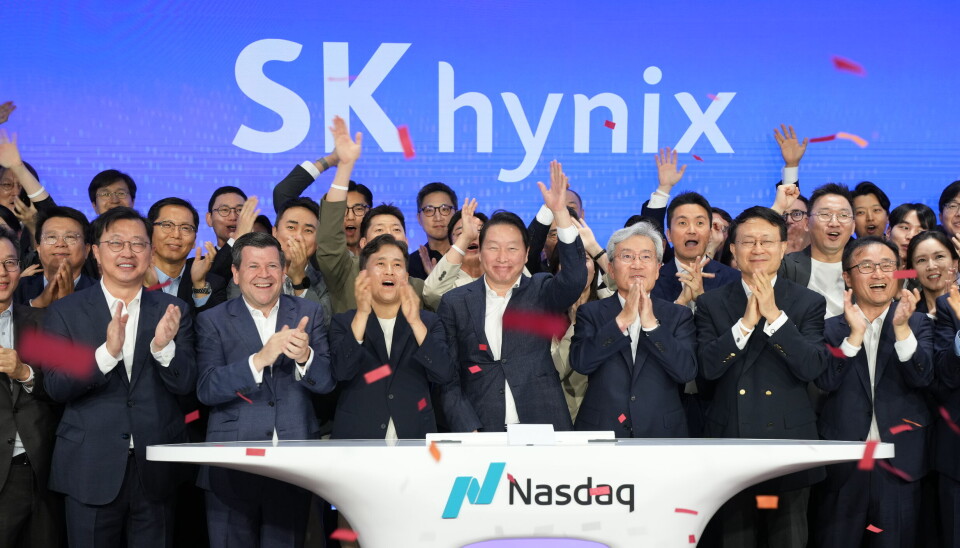
A logo of semiconductor and memory chip company SK hynix during the company's debut at the Nasdaq market in New York on July 10REUTERS/YONHAP
SK hynix's shares have plunged to roughly half their peak over the past month and brokerages have split outlooks for the stock.
Most securities firms lowered their price targets to reflect revised earnings forecasts and the recent share price correction. Korea Investment & Securities (KIS) on Thursday, however, raised its target after citing increased investment in AI infrastructure and a continuing shortage of memory chips.
It raised its price target for SK hynix by 23.7 percent to 4.7 million won ($3,300) from 3.8 million won. Shares were trading at 1.32 million won as of 9:30 a.m. on the same day.
“Prices are expected to continue rising in the third quarter and drive earnings growth,” Chae Min-sook, an analyst at KIS, said.
SK hynix announced on Wednesday that it generated 79.3 trillion won in revenue and 60.5 trillion won in operating profit in the second quarter, increases of 257 percent and 557 percent, respectively, from the second quarter of 2025.
Even so, the results fell short of market expectations, which sent the stock down 9.6 percent on Wednesday from the previous session.
“The decline in the share price was caused by the increase in dynamic random-access memory [DRAM] prices falling short of market expectations,” Chae said. “However, the company explained that this was due not to weaker demand but to delayed shipments, which will instead contribute to improved earnings in the third quarter.”
The analyst was optimistic about DRAM’s outlook.
SK hynix executives ring the Nasdaq opening bell in New York as confetti falls to celebrate the chipmaker’s American depositary receipt trading launch on July 10.NASDAQ
“Our previous forecast called for a 10 percent quarter-on-quarter increase in DRAM prices in the third quarter,” Chae said. “We now expect prices to rise about 20 percent.”
The analyst forecast SK hynix’s annual operating profit at 270 trillion won this year and 418 trillion won next year, up 10 percent and 11 percent respectively from their previous estimates.
Chae expects the two forces that have supported SK hynix shares — increased spending by operators of massive data centers and a shortage of memory chips — to continue.
“Even though memory prices have risen nearly fourfold from last year, hyperscalers continue to invest in AI infrastructure,” Chae said. “Production is being shipped immediately, which leaves both suppliers and customers unable to secure sufficient inventories. The shortage will become more severe in the second half of this year and into next year.”
Chae maintained that the company's long-term earnings outlook remains strong.
“Even if capital expenditure increases, the pace of supply growth will remain structurally constrained because production is shifting toward high bandwidth memory [HBM] and advanced processes,” Chae said. “This is a time to focus on the direction of the company’s value and earnings rather than short-term share price fluctuations.”
SK hynix executives celebrate the company's American depositary receipt trading launch in Times Square in New York on July 10.REUTERS/YONHAP
The KIS assessment stands apart from most revisions, with many securities firms recently lowering their price targets for SK hynix to reflect the decline in its share price and revised earnings forecasts.
Shinhan Securities cut its target to 2.7 million won from 4.2 million won.
“We believe the stock is in 'oversold' territory,” Kim Hyung-tae, an analyst at Shinhan Securities, said. “However, reflecting a more conservative pricing outlook, we lowered our operating profit estimates for 2026 and 2027 by 7 percent and 9 percent, respectively. We also applied a target valuation of 3.3 times for the 12-month forward price-to-book ratio in light of the broad decline in memory chip stocks.”
Kiwoom Securities lowered its target to 2.2 million won from 2.6 million won. NH Investment & Securities cut its target to 3.4 million won from 4.1 million won, while Daishin Securities reduced its target to 3.2 million won from 3.9 million won. Samsung Securities also lowered its target to 3 million won from 3.5 million won.
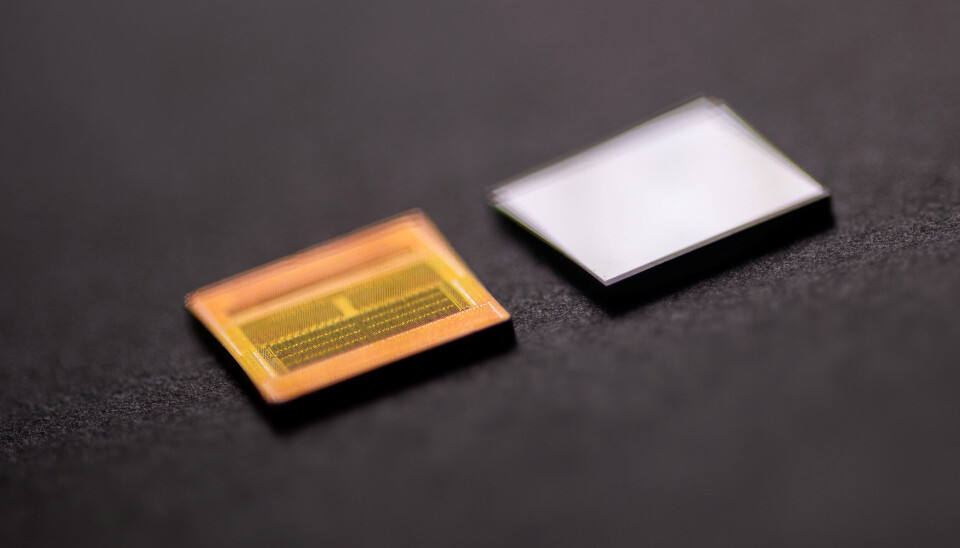
A highest-capacity, high-bandwidth 16-High HBM3E memory chip from SK hynix is seen in this studio photograph in San Francisco on Aug. 6, 2025.REUTERS/YONHAP
Despite the cuts, brokerages find SK hynix’s earnings growth remains on track, supported by increased investment in AI data centers and rising demand for HBM.
“Once some of the excessive expectations created by concentrated investment are corrected, we will realize that the direction in which we are heading has not changed,” Lee Jong-wook, an analyst at Samsung Securities, said. “We slightly lowered our price target to reflect investors’ changing risk appetite, but our buy recommendation remains unchanged.”
Mirae Asset Securities lowered its price target for SK hynix to 2.8 million won from 4.2 million won on Wednesday.
“We believed the share price correction caused by the lowered outlook for NAND contract prices had run its course, but concerns over China’s localization of lithography equipment immediately followed,” Kim Young-gun, an analyst at Mirae Asset Securities, said.
This article was originally written in Korean and translated by a bilingual reporter with the help of generative AI tools. It was then edited by a native English-speaking editor. All AI-assisted translations are reviewed and refined by our newsroom.