Bank of Korea Gov. Shin Hyun-song speaks during a meeting at the central bank's building in Jung District, central Seoul, on June 17.JANG JIN-YOUNGJANG JIN-YOUNG
Inflation may remain elevated even after the Iran war ends, with higher oil prices continuing to filter through prices of other goods and services.
Cost pressures from high oil prices and a weak won are expected to spill into manufactured goods and services. Rising wages and hefty bonuses paid by semiconductor companies could boost consumer spending, adding to inflationary pressures.
The Bank of Korea (BOK) said that inflation is likely to remain high for a considerable period in a report on Wednesday.
The central bank expects consumer inflation to hover around 3 percent in the second half of the year. Core inflation, which excludes food and energy prices, is projected to remain in the mid-to-high 2 percent range during the period. Both indicators are expected to stay above the central bank's 2 percent target even in 2027.
The oil price shock triggered by the Iran war was the main driver of inflation in the first half. The consumer price index increased by 2 percent in January and February, but jumped to 3.1 percent in May as the war broke out around end of February. Petroleum prices in May rose 24.2 percent from a year earlier. The living necessities index rose 3.3 percent in May, increasing the burden on low-income households.
An agreement between the United States and Iran to end the war has eased risks to oil prices. However, the central bank says it will take time for crude oil production and transportation to return to normal.
"Crude oil production isn't something that can be brought back online overnight," BOK Gov. Shin Hyun-song said during a briefing on Wednesday. "Rather than placing too much significance on day-to-day fluctuations in oil prices, we need to watch how long the trend persists."
The longer oil prices stay elevated, the greater and more persistent inflationary pressure becomes.
Historical data since 2000 show that when oil price shocks last longer than three months, a 10 percent increase in oil prices lifts core inflation by more than 0.1 percentage points five months later, with the impact persisting for seven months.
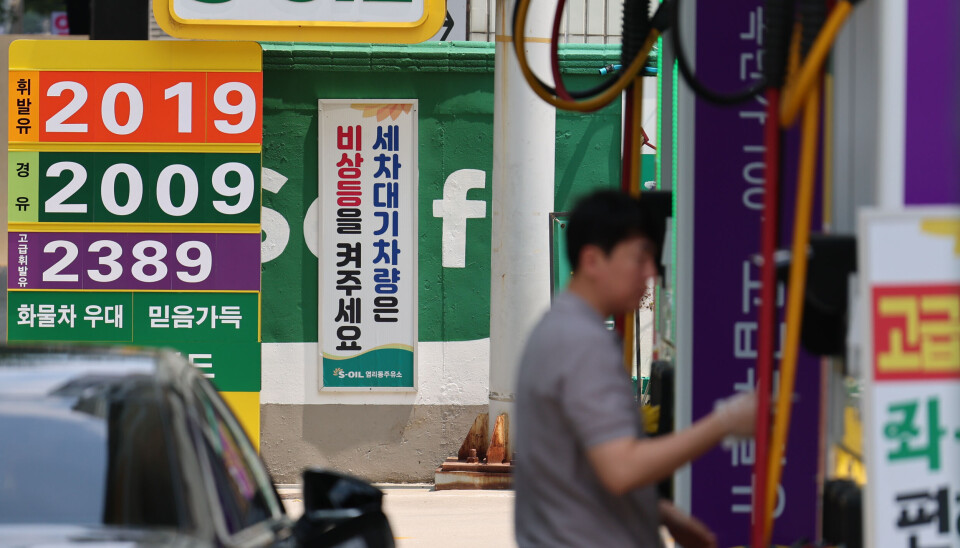
Prices are displayed at a gas station in Seoul on June 17.YONHAP
When oil price shocks were larger but short-lived, core inflation rose by only 0.06 percentage points and the effect lasted five months. The data suggest that how long oil prices remain elevated matters more for inflation than how much they rise.
A similar pattern emerged during the war in Ukraine, which broke out in February 2022. Oil prices reached $118 per barrel in June that year and then began to fall, but the indirect impact on non-petroleum goods continued to grow.
The indirect contribution of oil prices to consumer inflation averaged 0.89 percentage points between January and July 2022, but increased to 0.95 percentage points after August. The impact on non-energy items such as manufactured goods emerged about six months later and lasted roughly a year.
Wages are also emerging as a factor. Special payments, including performance bonuses, in the IT sector rose 60.6 percent on year in the first quarter. If more companies pay bonuses comparable to those offered by the top 10 percent of firms in their industry, consumer inflation rises by 0.05 percentage point about five months later.
"If special payments rise significantly at some companies, upward pressure on inflation could increase," the BOK said. "Recent bonuses in the IT sector are highly unusual, meaning the actual impact could be greater than expected."
Despite concerns about persistent inflation, Gov. Shin downplayed speculation that the central bank could consider a "big step," or a key interest rate increase of 0.50 percentage points.
"When discussion of a 'big step' first emerged, market conditions were difficult, with government bond yields and the [dollar-won] exchange rate both rising," Gov. Shin said. "The central bank will not be swayed by day-to-day market movements but will implement monetary policy based on the economy's underlying trends."
This article was originally written in Korean and translated by a bilingual reporter with the help of generative AI tools. It was then edited by a native English-speaking editor. All AI-assisted translations are reviewed and refined by our newsroom.