A person walks past a job information board at an employment and welfare center in Mapo District, western Seoul, on Oct. 16.NEWS1
The AI boom has created a semiconductor supercycle that boosted Korea's economy has made it harder for young people to find jobs, according to a central bank report released Monday.
Industrial restructuring, the use of AI and a rigid labor market are combining to weigh on youth employment, the Bank of Korea (BOK) said in the report. Economic growth has not translated into more quality jobs. On top of that, companies have favored experienced hires more strongly since AI began spreading, and entry-level and basic tasks traditionally handled by young people have been co-opted.
The BOK examined employment trends among people aged 15 to 29 across two tiers of the labor market: the primary market, which centers on regular jobs; and the secondary market, which includes temporary jobs and day labor. Under Korea's official employment statistics, regular jobs are those with no fixed term or a contract of a year or longer.
Ever since 2023, young people have increasingly lowered their expectations and entered the secondary labor market — typically defined as jobs with low pay and fringe benefits, low productivity and high turnover — first rather than wait for a place in the primary market, the report found.
Once there, however, they are finding it increasingly difficult to move on to better jobs. The share of young workers who moved from the secondary to the primary market was in the 8 percent range between 2014 and 2019 but fell to the 5 percent range in 2023 and 2024.
The BOK called this a "secondary labor market lock-in effect." Even if economic conditions and labor demand recover, the quality of young people's jobs may not improve easily if they cannot build enough job skills or lack a path to better positions, the bank said.
The bank identified a growth model centered on information technology (IT) manufacturing, including semiconductors, as a major cause of the decline in job quality for young people.
IT manufacturing has driven Korea's recent growth but creates relatively few regular jobs compared with its gains in output, the BOK found. Hiring for regular jobs remains heavily concentrated in non-IT manufacturing and services instead. As a result, rising semiconductor exports and production can lift the economy without immediately creating more of the regular jobs young people prefer, the bank said.
Young people have also been hit harder than other age groups by a stall in labor demand, the report found.
An illustration picture shows the ChatGPT application developed by U.S. AI company OpenAI displayed on a smartphone screen in Berlin on July 22.EPA/YONHAP
The spread of generative AI has also marked a turning point for youth employment and has resulted in companies increasingly favoring experienced hires, according to the report. That preference has grown stronger since late 2022, particularly in jobs and industries highly exposed to AI.
AI is rapidly taking over entry-level and basic tasks, which has cut demand for the work new employees mainly handled, the bank explained; companies instead want workers who can be put on the job right away.
The BOK warned that this trend could become a structural barrier for young people trying to enter industries that make heavy use of AI. It named three examples: finance and insurance; professional, scientific and technical services; and information and communications.
The BOK also pointed to Korea's employment protection system as one factor that makes it harder for young people to find jobs.
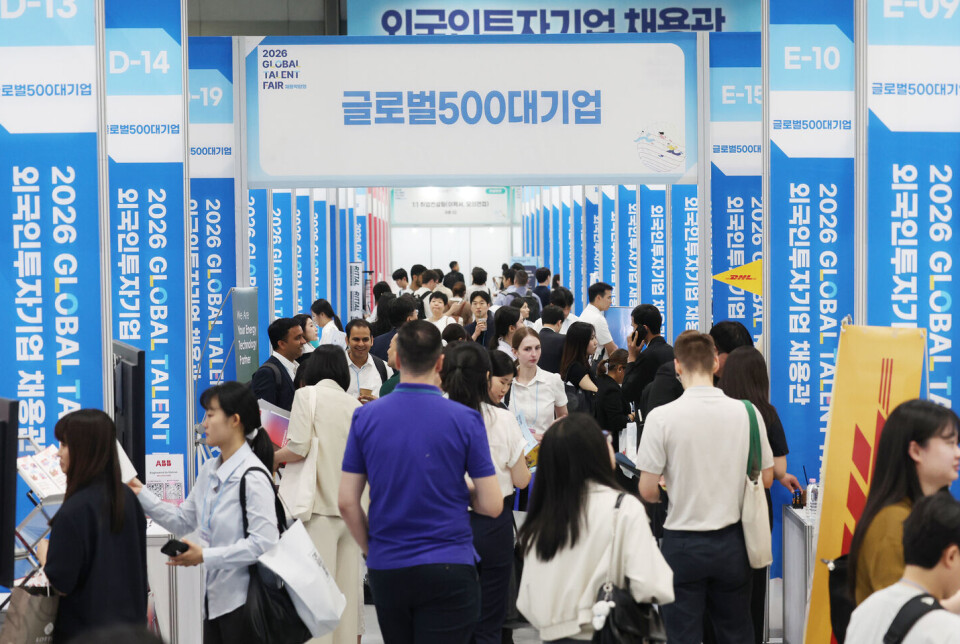
Job seekers attend the 2026 Global Talent Fair, a global recruitment expo, at Coex in Gangnam District, southern Seoul, on June 1.YONHAP
Countries with stronger employment protection tend to have lower youth employment rates, according to statistics from the Organisation for Economic Cooperation and Development cited by the bank. Korea's protection of permanent workers against individual dismissal ranks about No. 10 among 23 major countries, which the bank described as relatively high.
Policies that tackle only the supply of labor, as existing youth job programs do, cannot fundamentally solve the problem and therefore Industrial policy and structural reform of the labor market must be pursued together, the bank argued.
The bank proposed specific remedies: Policies that spread the employment benefits of IT manufacturing growth more widely; closer links between education and industry; and more flexible employment rules.
Even if semiconductors and AI become the core engines of economic growth, youth employment problems could persist unless Korea changes a structure in which the gains do not turn into quality jobs for young people, the bank concluded.
This article was originally written in Korean and translated by a bilingual reporter with the help of generative AI tools. It was then edited by a native English-speaking editor. All AI-assisted translations are reviewed and refined by our newsroom.